Gastric ulcers in the horse: how well behavioural signs predict the gastroscopy result
In 80 dressage horses referred for investigation, reported signs did not differ between horses with and without a lesion. What symptoms are really worth.
Scientific reviewPosition not yet filled, stated openly.
11 min readLast substantive review
Open access
Executive summary
Behavioural signs say less about the stomach than their reputation suggests. In 80 dressage horses, the frequency of owner-reported signs did not differ between horses with and without a lesion on gastroscopy, and their disappearance did not predict healing of the mucosa. Two distinct diseases hide under a single name, the squamous and the glandular form. Only gastroscopy establishes a finding.
20primary sources
5 %of them level 1 to 2
1species studied
2006–2026publication years
Key points
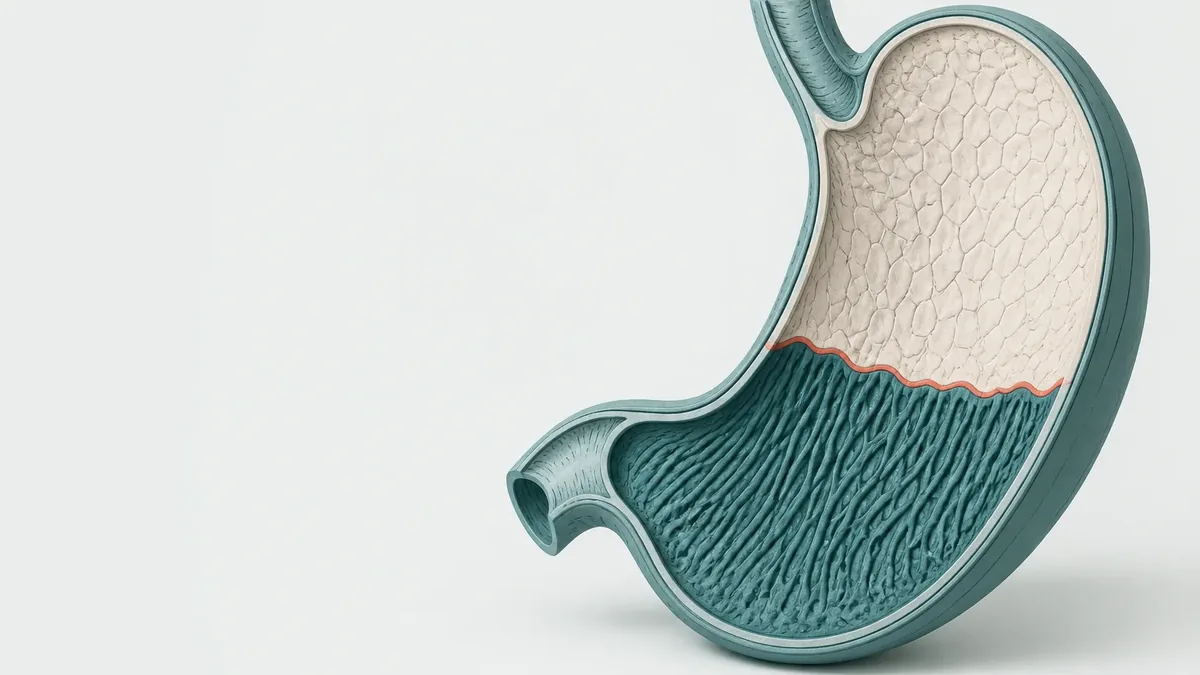
The specialist literature has separated two diseases under one name since 2015: the squamous form of the glandless upper part of the stomach and the glandular form of the mucosa that does carry glands.
In 80 dressage horses referred for investigation, the frequency of reported signs did not differ between the 55 horses carrying a lesion and the 25 that had none.
Of 37 horses presented for girth sensitivity, 12 had a gastric ulceration, 10 an orthopaedic problem and 3 a poorly fitting saddle.
The background frequency is high: 53 per cent in 201 Danish horses their owners considered healthy, and 75 to 87 per cent in the untreated comparison groups of seven randomised trials.
In 52 horses examined with the camera, the type of signs was associated with the site of the lesion, not with its severity.
Two diseases, one name
Anyone looking for information on gastric ulcers in the horse usually finds a single disease with a long list of symptoms attached. The specialist literature has separated two entities since 2015. The consensus statement of the European College of Equine Internal Medicine distinguishes disease of the squamous mucosa, that of the glandless upper part of the stomach, from disease of the glandular mucosa, which does carry glands. The two differ in how they arise, in their risk factors and in their response to treatment. The umbrella term that brings them together has been in use since 1999.
This separation is not a subtlety for specialists: it governs the interpretation of every single sign. A review from 2023 notes that a large share of the work on the glandular form appeared only after the consensus statement. Reading a symptom list that merges the two forms therefore means reading a list asked to answer two different questions at once.
Why is outward observation not enough?
Because in the living horse both mucosal surfaces can be seen only by endoscopy. The consensus statement names gastroscopy expressly as the only method that establishes a diagnosis. Everything that comes before it remains a suspicion. How solid that suspicion is can nevertheless be measured, and that is exactly what several research groups have done.
The denominator the symptom lists leave out
A sign is never worth more than the frequency of the disease it is meant to announce. And that frequency is high. In a Danish study of 201 horses that their owners considered healthy and that were not in race training, more than half carried a lesion judged significant: 53 per cent. An editorial from 2025 gathers, for sport horses, frequencies of 50 to 70 per cent for the squamous form and up to 75 per cent for the glandular form.
In horses in training the picture is sharper still. In a synthesis of seven randomised trials covering 566 horses, the untreated comparison groups showed ulceration in 75.3 and 87.2 per cent of cases depending on the subgroup. Finding a lesion in a horse in training is therefore the normal case, and not a discovery.
The obvious counter-calculation does not hold either. In an Icelandic cohort, 81 horses were examined with the camera within two weeks of moving from pasture into the stable: 71.6 per cent already carried a significant squamous lesion. Eight weeks later, in training and with conserved forage fed several times a day, the figure was 25.4 per cent. The authors attribute the difference expressly to the forage feeding and not to the behaviour of the horses.
What reported signs actually predict
The most direct test so far dates from 2025. In all, 80 dressage horses in competition were referred by their vets for investigation and examined with the camera; 55 carried a lesion, 25 did not. The comparison covered how often owners reported particular signs. Across the whole group, the most frequently named were girth sensitivity in 78 per cent, declining performance in 33 per cent and weight loss in 30 per cent. The frequency of these signs did not differ between horses with and without a lesion.
The result has two sides, and both count. Neither the reported signs nor a test for occult blood in the droppings reached a rate of correct answers sufficient to carry out a pre-selection. And in the 19 horses re-examined with the camera after treatment, the disappearance of the signs did not predict healing of the mucosa: the agreement between what owners reported and what the camera showed was poor.
Is this a new finding?
No. As early as 2006, a Swedish study of 80 Standardbreds in training reached the same conclusion: age, sex, performance, behaviour and feeding habits gave only weak pointers to which horses were affected. Of all the characteristics examined, only training status was clearly associated with squamous lesions.
An Icelandic cross-sectional study of 211 riding horses from 21 premises examined a broader list in 2023. Neither body condition, nor behaviour in the box and the paddock, nor the intensity and frequency of work, nor age were clearly associated with the ulcer score. What was associated instead were management characteristics: the region, the sex, the time spent in the paddock and the proportion of non-structural carbohydrates in the ration. The same work does report, however, that horses showing the signs usually attributed to the stomach more often had a significant glandular and a severe squamous change. The signs are therefore not worthless: they are weak and unspecific.
Girth sensitivity: the textbook case
No sign is tied to the stomach as firmly as sensitivity when the girth is tightened. The figures behind it are sobering. In an American case series, 37 horses were presented between 2004 and 2016 for girth sensitivity. In 12 of them it was a gastric ulceration, in 10 an orthopaedic problem of varying kind, in 3 a poorly fitting saddle, in 1 a tumour of the reproductive tract and in 10 other conditions, among them a liver abscess, an aneurysm of the caudal vena cava, sternal pain and a urinary tract infection. That list covers 36 of the 37 horses. The authors themselves note that the exact cause of girth sensitivity remains hard to establish.
The reverse direction is just as instructive. In the populations gathered by the 2025 editorial, 25 per cent of the horses carrying a squamous lesion and 31 per cent of those carrying a glandular lesion showed girth sensitivity. Put differently: about seven horses in ten whose gastric involvement was established did not react noticeably to girthing. A sign that is absent in the majority of affected horses and occurs at a similar frequency in the others does not separate the two groups.
The site of the lesion says more than its extent
A 2026 study of 52 horses examined with the camera asked which type of sign goes with which lesion. The pattern was clear: physical signs appeared above all with squamous involvement, behavioural signs and mixed pictures above all with glandular or mixed involvement. What did not appear was just as clear: between the severity of the lesions and the clinical signs there was no link at all. The discipline the horse was used for was likewise associated both with the type of signs and with the site of the lesion.
This work describes the distribution of signs in horses already diagnosed. There was no comparison group free of findings on gastroscopy, and therefore no statement either about how accurate a sign is. It is a single result, not replicated to date, and the authors write themselves that the relationship between the site of the lesion and the clinical picture remains poorly defined.
A study of 109 Thoroughbreds across eight training yards in Great Britain and Australia likewise found different patterns for the two forms, one of which contradicts the common image: horses that behaved aggressively towards people less often had a squamous lesion, and not more often. Horses with stereotypies had one more often. Work spread over five or more days a week went together with a clearly raised risk of the glandular form, as did racing below expectations. The estimates are imprecise; the direction is less so.
The counter-test: what else explains behaviour
To attribute a sign to the stomach, one has to know how often it has other explanations. On this point the figures are solid. In a convenience sample of 60 riding horses whose owners considered them free of complaints, 73 per cent were lame on at least one limb, mostly mildly. Behaviour under saddle was explained in that study by two quantities: lameness and the skill of the person riding.
The most striking counter-test comes from 150 horses investigated for declining performance. After a musculoskeletal source of pain had been removed by diagnostic anaesthesia, in some cases together with a change of saddle, the behaviour score under saddle fell from a median of 9 to 2 out of a possible 24 points. Only 30.0 per cent of these horses were consistently lame, and 37.3 per cent wore a saddle judged to fit badly enough to affect performance. There was no link between the behaviour score and the degree of lameness. This work did not perform gastroscopy: it therefore says nothing about how many of these horses also carried a gastric lesion.
And even once lameness has been ruled out, the list stays long. In 259 non-lame Standardbreds examined for declining performance, equine asthma and gastric disease headed the diagnoses, ahead of exercise-induced pulmonary haemorrhage, dynamic narrowing of the upper airways, cardiac rhythm disturbances and exertional myopathies. The 2025 editorial further cites an analysis in which 84 per cent of 275 racehorses referred for declining performance had more than one possible cause after full investigation.
The yardstick has its limits too
Gastroscopy is the yardstick against which everything else is measured, and it too is not free of error. In one study, six people assessed 60 anonymised video recordings. With the ordinal grading system of the EGUS Council, agreement between assessors was substantial for both mucosal surfaces, without being complete, and a little higher within the same person at two different times. A visual analogue scale performed clearly worse, especially for the glandular mucosa, and depended in addition on the experience of the person assessing.
This work says nothing about the correctness of the assessment, only about its repeatability, and it rests on video recordings rather than on examining the horse. In everyday practice, with varying image quality and preparation, the spread is likely to be greater. For the question asked in this article that means the yardstick against which behavioural signs fail is not itself a perfect yardstick.
The reverse route, measuring the pain rather than the lesion, has not proved a shortcut either. A validated facial expression scale did not separate, among 61 horses, the animals carrying gastric lesions from those without, and its value did not rise with severity. The authors expressly do not conclude that gastric ulcers are painless: they hold that this instrument does not capture that pain, and call for other scales to be tested. Lame horses and horses with systemic inflammation were excluded, that is, precisely the group most common in practice.
When signs persist or disappear
Part of the puzzle dissolves if behaviour is seen not as a simple readout but as something learnt. A clinical commentary from 2025 describes problem behaviours persisting in some horses after healing confirmed on gastroscopy: as learnt, anticipatory reactions to a pain once experienced. Conversely, part of the behaviour gives way after treatment. The two together explain why the disappearance of a sign does not prove a cure, and its persistence does not prove a failure.
There are studies pointing the other way, and they belong in the picture. In a clinical study of 63 sport horses carrying a glandular lesion, healing of the lesions was associated with the disappearance of the clinical signs; declining performance was the most common presenting sign in both groups, in 65.1 per cent overall. The authors conclude from this that the glandular form does indeed produce clinical signs. The reservation lies in the design: the clinical data came from questionnaires sent to owners who knew which treatment their horse had received.
Just as double-edged is a trial in nine show jumpers from the same yard. After twelve weeks on a low-starch ration instead of one rich in sugar and starch, the gastric score and the behaviour score under saddle fell together, and the two values were closely linked. The recordings were assessed blind. There was, however, neither a comparison group nor random allocation: twelve additional weeks of training explain part of the change on their own. And two values falling together says nothing about which of them moves the other.
What a single sign carries in the source set, and what it does not
Original analysis
For each commonly cited gastric sign, the table records in which of the studies used here it was actually measured, what link with the gastroscopic finding is reported there, what other explanations are documented in the same source set, and which conclusion, precisely, does not follow.
Sign
Where it was measured
Reported link with the finding
Other explanations documented in the source set
What does not follow
Girth sensitivity
80 dressage horses; 37 horses in a case series; populations gathered by an editorial
Reported in 78 per cent of the whole group, with no difference between horses with and without a lesion; present in 25 to 31 per cent of horses whose involvement was established
Orthopaedic problem, poorly fitting saddle, tumour of the reproductive tract, liver abscess, sternal pain, urinary tract infection
That girth sensitivity points to the stomach
Declining performance
80 dressage horses; 63 sport horses with a glandular lesion; 259 non-lame Standardbreds; 109 Thoroughbreds
Reported in 33 per cent of the dressage group, with no difference between groups; the most common presenting sign in 65.1 per cent of glandular cases
Equine asthma, exercise-induced pulmonary haemorrhage, dynamic narrowing of the upper airways, cardiac rhythm disturbance, exertional myopathy
That the cause has been found as soon as a gastric lesion is present
Weight loss
80 dressage horses
Reported in 30 per cent of the whole group, with no difference between horses with and without a lesion
Not set against other causes in the studies used here
That weight loss points to the stomach
Aggression towards people
109 Thoroughbreds in race training
Inverse link: less often with a squamous lesion, and not more often
Not broken down further in the same dataset
That aggression grounds a suspicion of the stomach
Stereotypies such as crib-biting or weaving
109 Thoroughbreds in race training; 211 Icelandic riding horses
In the Thoroughbreds more often associated with a squamous lesion; in the Icelandic horses, behaviour in the box and the paddock was not associated with the ulcer score
Management, feeding and the training yard itself emerged as factors in their own right
That a stereotypy is caused by the gastric lesion
Facial expression at rest
61 horses, seven assessors
No difference between horses with and without a lesion, no rise with severity
Lame horses and horses with systemic inflammation were excluded
That gastric ulcers are painless
Behaviour under saddle
60 riding horses believed free of complaints; 150 horses with musculoskeletal pain; 9 show jumpers
In the 9 show jumpers the behaviour score fell at the same time as the gastric score, with no comparison group
Lameness and the skill of the person riding; the score fell from 9 to 2 out of 24 after musculoskeletal pain was removed
That a high behaviour score points to the stomach
Behaviour in the box and the paddock
211 Icelandic riding horses from 21 premises
Not significantly associated with the ulcer score
Region, sex, time in the paddock, proportion of non-structural carbohydrates and a change of pasture within four weeks
That calm behaviour in the stable rules out a lesion
Limitations and uncertainty
On this question there is neither a systematic review nor a randomised trial. Of the studies used here, only one, a meta-analysis on drug prevention, reaches the level of systematic review, meta-analysis or randomised trial, and it precisely does not answer the question of this article. The editorial requirement to base at least half the sources on that level is not achievable in this field at present: the rest consists of cross-sectional, cohort, case-control and case-series studies, one consensus statement and two opinion pieces.
The study of 80 dressage horses concerned an already selected population, referred for gastric investigation, in which 69 per cent carried a lesion. In a group without that pre-selection, the rate of correct answers for a sign is different. Values for individual signs were moreover not published.
Several key papers come from the same circles of authors: the 2025 editorial and the 2025 clinical commentary share authors, and neither brings data of its own. These are therefore not two confirmations independent of one another.
The populations compare poorly with one another: Thoroughbreds in race training, Icelandic riding horses on a low-starch ration, competition dressage horses, Standardbreds. No figures specific to Swiss leisure horses could be found in this search.
The studies that measure behaviour under saddle and the studies that perform gastroscopy are almost never the same. Where the stomach was examined, orthopaedic investigation was usually missing, and where orthopaedic investigation was carried out, gastroscopy was missing. How often the two occur together is therefore unknown.
The study linking the type of signs to the site of the lesion covers 52 horses, has no healthy comparison group and has not been replicated to date.
Open questions
How accurate is a single sign in an unselected population of leisure horses, that is, where the background frequency should be lower than in the groups studied so far?
Can the pattern by which physical signs belong rather to the squamous form and behavioural signs rather to the glandular form be reproduced?
How often do a gastric lesion and musculoskeletal pain occur together in the same horse, when both systems are examined in the same session?
Is there an instrument able to capture gastric pain in the horse, after a validated facial expression scale has failed at it?
Frequently asked questions
Can I recognise gastric ulcers without gastroscopy?
Not reliably. In the study of 80 dressage horses referred for investigation, the frequency of the signs owners reported did not differ between horses with and without a lesion, and a test for occult blood in the droppings gave no usable separation either. As early as 2006, a Swedish study of 80 Standardbreds held that age, sex, performance, behaviour and feeding habits give only weak pointers. The 2015 consensus statement names gastroscopy as the only method that establishes a diagnosis. Whether such an examination is indicated is decided at the veterinary practice.
My horse is girth-sensitive. Does that mean it has gastric ulcers?
Not necessarily. In a case series bringing together 37 horses presented for girth sensitivity, 12 had a gastric ulceration, 10 an orthopaedic problem, 3 a poorly fitting saddle, 1 a tumour of the reproductive tract and 10 other conditions. Conversely, in the figures of a 2025 editorial, only 25 to 31 per cent of the horses whose involvement was established showed girth sensitivity at all. The sign is therefore absent in the majority of affected horses and at the same time has many other causes. It justifies an investigation, but grounds no diagnosis.
How can I tell whether it is the squamous or the glandular form?
From the signs alone, with no certainty at all. A 2026 study of 52 horses examined with the camera did find a pattern: physical signs rather with squamous involvement, behavioural signs rather with glandular or mixed involvement. That result comes, however, from a small group without healthy comparison horses and has not been replicated to date. The same work also shows something else: the severity of the lesions was not associated with the clinical signs. In the living horse, only gastroscopy shows which mucosa is affected.
My horse resists under saddle. Where does the most common explanation lie?
The evidence suggests that the stomach is neither the only candidate nor regularly the first. Among 60 riding horses whose owners considered them free of complaints, 73 per cent were mildly lame, and behaviour under saddle was explained by lameness and the skill of the person riding. Among 150 horses investigated for declining performance, the behaviour score fell from a median of 9 to 2 out of 24 points after a musculoskeletal source of pain had been removed. The order in which an investigation proceeds belongs to the veterinary practice.
The signs have gone after treatment. Is my horse cured?
One does not follow from the other. In the 19 horses re-examined with the camera after treatment, the improvement owners reported agreed poorly with the gastroscopic result. A clinical commentary from 2025 further describes some behaviours persisting as a learnt, anticipatory response even though the lesion has healed. Conversely, part of the behaviour does give way after treatment. Signs that have gone therefore prove no cure, and signs that persist prove no failure.
A lesion was found. Does it explain my horse's behaviour?
Not automatically. Among 201 Danish horses their owners considered healthy, 53 per cent carried a lesion judged significant, and in the untreated comparison groups of seven randomised trials in horses in training the figure was 75 to 87 per cent. At that frequency, almost every gastroscopy finds something. A 2025 editorial warns expressly against moving from a lesion found to the cause of the behaviour. In one analysis cited, 84 per cent of 275 racehorses referred for declining performance had more than one possible cause.
Sources
Sykes BW, Hewetson M, Hepburn RJ, Luthersson N. European College of Equine Internal Medicine Consensus Statement--Equine Gastric Ulcer Syndrome in Adult Horses. Journal of Veterinary Internal Medicine, 2015 (Professional guideline | Horse)DOI 10.1111/jvim.13578 Consensus statement that formally separates two entities gathered under a single name, disease of the squamous mucosa and disease of the glandular mucosa, and names gastroscopy as the only method allowing an established diagnosis.
Vokes J, Lovett A, Sykes B. Equine Gastric Ulcer Syndrome: An Update on Current Knowledge. Animals (Basel), 2023 (Other | Horse)DOI 10.3390/ani13071261 Narrative review without data of its own: the umbrella term has been in use since 1999, the separation of the two forms was formalised in 2015, and a large share of the work on the glandular form appeared only afterwards.
Luthersson N, Nielsen KH, Harris P, Parkin TDH. The prevalence and anatomical distribution of equine gastric ulceration syndrome (EGUS) in 201 horses in Denmark. Equine Veterinary Journal, 2009 (Cross-sectional study | Horse)DOI 10.2746/042516409x441910 In 201 Danish horses outside race training, judged healthy by their owners, the frequency of a lesion considered significant reached 53 per cent, with the most severe lesions usually sited at the margo plicatus.
Mason LV, Moroney JR, Mason RJ. Prophylactic therapy with omeprazole for prevention of equine gastric ulcer syndrome (EGUS) in horses in active training: A meta-analysis. Equine Veterinary Journal, 2019 (Meta-analysis | Horse)DOI 10.1111/evj.12951 Synthesis of seven randomised trials covering 566 horses on drug prevention: in the untreated comparison groups the frequency of ulceration reached 75.3 and 87.2 per cent depending on the subgroup; clinical signs were not recorded.
Luthersson N, Ýr Þorgrímsdóttir Ú, Harris PA, Parkins T. Effect of moving from being extensively managed out in pasture into training on the incidence of equine gastric ulcer syndrome in Icelandic horses. Journal of the American Veterinary Medical Association, 2022 (Cohort study | Horse)DOI 10.2460/javma.22.06.0263 In 81 Icelandic horses coming straight off pasture, the frequency of a significant squamous lesion reached 71.6 per cent and fell to 25.4 per cent after eight weeks of training with conserved forage fed regularly; the authors attribute this to the forage feeding.
Sykes B, Lovett A. Can All Behavioral Problems Be Blamed on Equine Gastric Ulcer Syndrome?. Animals (Basel), 2025 (Other | Horse)DOI 10.3390/ani15030306 Editorial without data of its own: it does not dispute that gastric lesions hurt, but warns against moving automatically from behaviour to the stomach, noting among other things that 25 and 31 per cent respectively of horses carrying a squamous or a glandular lesion were girth-sensitive, and that 84 per cent of 275 racehorses referred for declining performance had more than one possible cause.
Frippiat T, Bonhomme M, Dyson S, Votion DM. Evaluation of Owner-Reported Clinical Signs and Fecal Occult Blood Tests as Predictors of Equine Gastric Ulcer Syndrome in Competition Dressage Horses. Journal of Veterinary Internal Medicine, 2025 (Case-control study | Horse)DOI 10.1111/jvim.70248 In 80 competition dressage horses referred for investigation, 55 of which carried a lesion, the frequency of owner-reported signs did not differ between cases and comparison horses free of findings on gastroscopy, and in the 19 horses re-checked the disappearance of the signs did not predict healing of the mucosa.
Jonsson H, Egenvall A. Prevalence of gastric ulceration in Swedish Standardbreds in race training. Equine Veterinary Journal, 2006 (Cross-sectional study | Horse)DOI 10.2746/042516406776866390 In 80 Swedish Standardbreds in training, age, sex, performance, behaviour and feeding habits gave only weak pointers to which horses were affected; of the characteristics examined, only training status was clearly associated with squamous lesions.
Luthersson N, Þorgrímsdóttir ÚÝ, Harris PA, Parkin T. Risk Factors for Equine Gastric Ulcer Syndrome Incidence in Adult Icelandic Riding Horses. Animals (Basel), 2023 (Cross-sectional study | Horse)DOI 10.3390/ani13223512 In 211 Icelandic riding horses from 21 premises, body condition, behaviour in the box and the paddock, work intensity and age were not clearly associated with the ulcer score, unlike certain management characteristics; horses showing the signs usually attributed to the stomach did, however, more often have a significant glandular and a severe squamous change.
Millares-Ramirez EM, Le Jeune SS. Girthiness: Retrospective Study of 37 Horses (2004-2016). Journal of Equine Veterinary Science, 2019 (Case series | Horse)DOI 10.1016/j.jevs.2019.05.025 Of 37 horses presented for girth sensitivity, 12 had a gastric ulceration, 10 an orthopaedic problem, 3 a poorly fitting saddle, 1 a tumour of the reproductive tract and 10 other conditions; the authors hold that the exact cause of girth sensitivity remains hard to establish.
Pimenta J, Martins B, Mexedo A, Campilho R. Physical vs. Behavioral Clinical Signs in Horses with Squamous and Glandular Gastric Ulcers. Veterinary Sciences, 2026 (Cross-sectional study | Horse)DOI 10.3390/vetsci13040328 In 52 horses examined by gastroscopy, the type of clinical signs was associated with the site of the lesion, physical signs rather with squamous involvement, behavioural signs and mixed pictures rather with glandular or mixed involvement, while no link existed between the severity of the lesions and the clinical signs.
Sykes BW, Bowen M, Habershon-Butcher JL, Green M. Management factors and clinical implications of glandular and squamous gastric disease in horses. Journal of Veterinary Internal Medicine, 2019 (Cross-sectional study | Horse)DOI 10.1111/jvim.15350 In 109 Thoroughbreds from eight training yards, management factors and clinical signs differed between the two forms: aggression towards people was inversely associated with the squamous lesion, stereotypies more often with it, and work on five or more days a week as well as performance below expectations went together with the glandular form.
Dyson S, Pollard D. Application of a Ridden Horse Pain Ethogram and Its Relationship with Gait in a Convenience Sample of 60 Riding Horses. Animals (Basel), 2020 (Cross-sectional study | Horse)DOI 10.3390/ani10061044 In 60 riding horses whose owners considered them free of complaints, 73 per cent were lame on at least one limb, and the behaviour score under saddle was explained by lameness and the skill of the person riding; none of these horses underwent gastroscopy.
Dyson S, Pollard D. Application of the Ridden Horse Pain Ethogram to 150 Horses with Musculoskeletal Pain before and after Diagnostic Anaesthesia. Animals (Basel), 2023 (Cohort study | Horse)DOI 10.3390/ani13121940 In 150 horses examined for declining performance, the behaviour score under saddle fell from a median of 9 to 2 out of 24 points after a musculoskeletal source of pain had been removed, in some cases with a change of saddle, with no link between behaviour score and degree of lameness.
Lo Feudo CM, Stucchi L, Conturba B, Stancari G. Medical causes of poor performance and their associations with fitness in Standardbred racehorses. Journal of Veterinary Internal Medicine, 2023 (Cohort study | Horse)DOI 10.1111/jvim.16734 In 259 non-lame Standardbreds with declining performance, moderate equine asthma and gastric disease were the most frequent diagnoses, ahead of exercise-induced pulmonary haemorrhage, dynamic narrowing of the upper airways, cardiac rhythm disturbances and exertional myopathies.
Wise JC, Wilkes EJA, Raidal SL, Xie G. Interobserver and intraobserver reliability for 2 grading systems for gastric ulcer syndrome in horses. Journal of Veterinary Internal Medicine, 2021 (Other | Horse)DOI 10.1111/jvim.15987 When 60 anonymised gastroscopy videos were assessed by six people, agreement with the ordinal system of the EGUS Council was substantial and largely independent of experience level, while a visual analogue scale performed clearly worse, especially for the glandular mucosa.
Ferlini Agne G, May BE, Lovett A, Simon O. Horse Grimace Scale Does Not Detect Pain in Horses with Equine Gastric Ulcer Syndrome. Animals (Basel), 2023 (Cross-sectional study | Horse)DOI 10.3390/ani13101623 A validated facial expression scale did not separate, among 61 horses, the animals carrying gastric lesions from those without and did not rise with severity; the authors do not conclude that gastric lesions are painless, but that this instrument does not capture that pain.
Klinck M, Lovett A, Sykes B. Incorporating a Behavioral Medicine Approach in the Multi-Modal Management of Chronic Equine Gastric Ulcer Syndrome (EGUS): A Clinical Commentary. Animals (Basel), 2025 (Other | Horse)DOI 10.3390/ani15203019 Clinical commentary without data of its own: it describes how problem behaviours can persist in some horses as learnt, anticipatory pain responses after healing confirmed on gastroscopy, while another part gives way after treatment.
Varley G, Bowen IM, Habershon-Butcher JL, Nicholls V. Misoprostol is superior to combined omeprazole-sucralfate for the treatment of equine gastric glandular disease. Equine Veterinary Journal, 2019 (Controlled trial | Horse)DOI 10.1111/evj.13087 In 63 sport horses carrying a glandular lesion, healing of the lesions was associated with the disappearance of the clinical signs, and declining performance was, at 65.1 per cent overall, the most common presenting sign; the clinical data came, however, from owners who knew the treatment received.
Pineau V, Ter Woort F, Julien F, Vernant M. Improvement of gastric disease and ridden horse pain ethogram scores with diet adaptation in sport horses. Journal of Veterinary Internal Medicine, 2024 (Cohort study | Horse)DOI 10.1111/jvim.17223 In nine show jumpers from the same yard, the gastric score and the behaviour score under saddle fell together after twelve weeks on a low-starch ration and were strongly correlated, but without a comparison group and without random allocation, so the direction of the link remains open.
ForschungPferd (2026). Gastric ulcers in the horse: how well behavioural signs predict the gastroscopy result. ForschungPferd, English. https://forschungpferd.ch/en/equine-health/gastric-ulcers-behavioural-signs/