
Equine Health
Autumn ACTH in the horse: what a seasonal reference range really tells you
In autumn ACTH rises in healthy horses too: where the 29 and 47 pg/ml limits come from, and what breed, age and laboratory shift.
HOHorseArobust Open access

HOHorseBmoderate
After a strangles outbreak, 3 to 37 per cent of horses stayed carriers depending on herd and method: what is documented on silent carriers.
Executive summary
Some horses stay infectious after recovering from strangles without looking ill: Streptococcus equi persists in the guttural pouches, often without any outward sign. In individual herds the proportion of carriers after the outbreak lay between 3 and 37 per cent depending on the detection method, and shedding periods of seven to thirty-nine months are documented. Clinical examination and blood tests do not identify these horses.
Key points
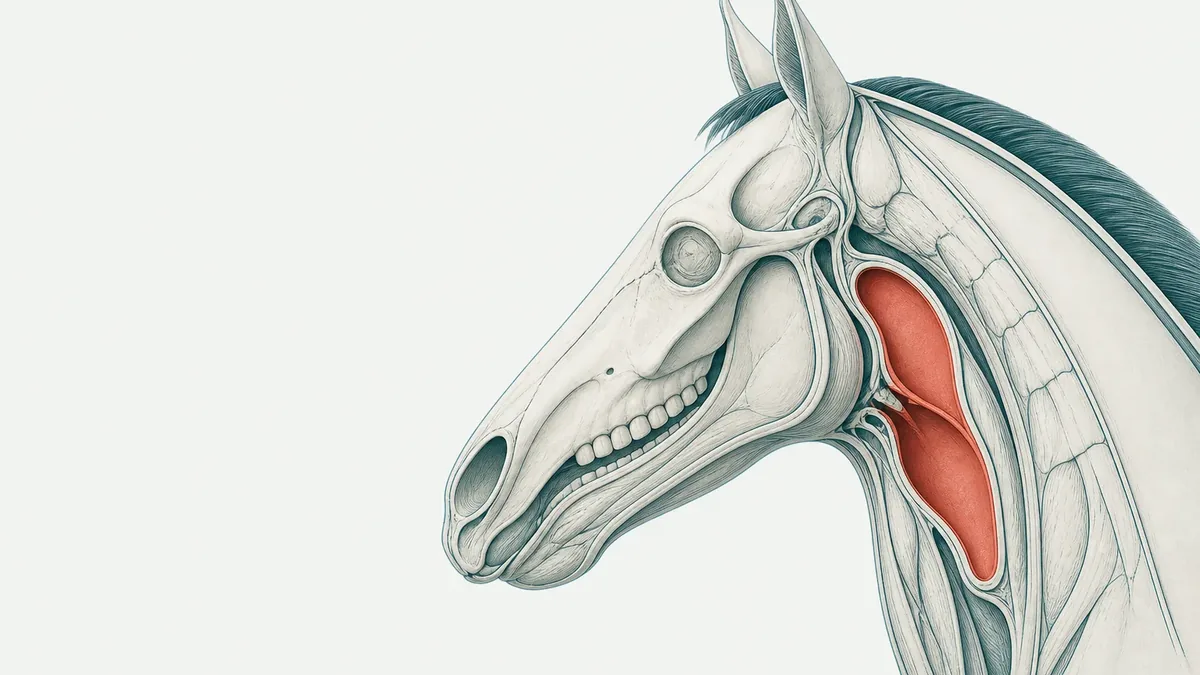
Strangles is a bacterial infection of the horse's upper airways, caused by Streptococcus equi subspecies equi. The acute picture, with fever, nasal discharge and swollen lymph nodes, is well known. What happens afterwards is far less so. In some horses the organism does not disappear along with the signs: it withdraws into the guttural pouches, two air-filled outpouchings of the Eustachian tube inside the horse's head. There it can persist for months without anything being visible on the animal. Such horses are called silent carriers, or long-term carriers.
The figure that circulates most often on this point runs as follows: around one tenth of recovered horses develops a persistent infection of the guttural pouches. It is an order of magnitude settled within the discipline, not a measurement. It appears as an opening sentence, among other places in a genomic study of 670 isolates from 19 countries, without that study having established it itself. The values actually measured lie far apart, and that is precisely where the heart of the subject lies.
The guttural pouches communicate with the pharynx only through a narrow opening and drain poorly by themselves. Pus can thicken there and form firm lumps, known as chondroids. In a series of 14 carriers without symptoms from three outbreaks, the infection sat in the guttural pouches in 13 of them. It is reachable there, but only with an endoscope.
A revised consensus statement published in 2018 by a panel of specialists gives particular prominence to the importance of these carrier states for transmission, and at the same time redefines what should count as the reference method for detection. It is an ordering text produced by an expert panel, not a measurement of its own, and it can therefore support none of the figures in this article.
The most robust figures come from outbreaks that were followed for months. In three protracted British outbreaks on holdings of differing kinds, 29 to 52 per cent of the horses sampled were infected depending on the yard, and between 9 and 44 per cent of the infected animals still carried the organism after the clinical signs had gone. The guttural pouch was the dominant site.
Two outbreaks followed later show how strongly these proportions depend on the detection method. In a herd of 98 yearlings, in which around half the animals had been ill, the proportion of carriers stood at 3 per cent on culture and at 15 per cent on PCR. In a second herd of 38 adult Icelandic horses, in which every animal had been ill, it reached 13 against 37 per cent. Every horse positive on culture was also positive on PCR; the reverse does not hold. A horse negative on culture and positive on PCR must therefore, in the authors' view, be treated as carrying live bacteria until the contrary is established.
Carriers also come to light outside documented outbreaks. In an American clinical review of 108 strangles cases, 12 of 25 horses infected for longer than forty days showed no clinical signs at all. The comparison limps, however: carriage is defined here by the duration recorded in the case file, not by an endoscopically confirmed guttural pouch finding.
The longest documented courses come from a 1997 study on a holding with around 1,500 horses. Long-term carriage was demonstrated there in four clinically healthy convalescents and in two of 350 newly introduced ponies, and it lasted between seven and thirty-nine months. In the three British outbreaks of the following years, prolonged shedding lasted up to eight months.
One finding of the same work is rarely quoted and is nonetheless the most uncomfortable: in these horses, prolonged shedding did not stop of its own accord before treatment was begun. What would have happened without intervention the data do not say, because every affected animal was treated. In an accompanying series, 14 of 15 carriers were cleared under veterinary treatment without surgery, a third of them only at the second attempt. That series has no comparison group: it shows that clearance is possible, not which approach would be the best.
No. In an Icelandic outbreak, ten persistent carriers were sampled eleven times over thirteen months. Of 115 samples, 61 were positive on PCR and only 32 of those were positive on culture as well. A carrier can therefore appear unremarkable for weeks and then release live bacteria again.
The same work also showed that the organism changes within the carrier. Three months after the first sample, variants appeared carrying a single substitution in the surface gene; after six months, in two horses, shortened forms of the same gene. One of these forms persisted and turned up later in two further horses. A carrier is accordingly not a reservoir at rest but an inhabited place, in which the organism goes on evolving and from which it is evidently passed on.
What decides the matter is not the refinement of the test but the place where the search is made. In a study of 44 convalescents, every horse was sampled in three ways: with a swab from the nasopharynx, with a lavage of the same region and with a lavage of the guttural pouches. Positive were 1 of 41 swabs, 6 of 38 nasopharyngeal lavages and 24 of 44 guttural pouch lavages. The authors put the difference in favour of the guttural pouch sample at a factor of 51. It is a ratio of odds, as they themselves report it, not a probability in the strict sense.
The 1997 work already pointed in the same direction: a single culture from the swab found 45 per cent of the carriers, a single culture from the endoscopically obtained guttural pouch lavage 88 per cent. Repeated swabbing over two to three months eventually found the organism in all but one of the carriers, but with runs of negative results lasting weeks in between.
Even in the acute phase detection is not certain. In a Swedish series of 57 horses from eight confirmed outbreaks, PCR run directly on the nasopharyngeal lavage found the most infected animals, 48 of 57, against at most 22 of 57 for biochemical identification after culture. Three horses stayed negative on every sample.
No, and this has been checked several times. Among 287 horses at a quarantine facility, nine were guttural pouch carriers, and no recognisable link existed between serology and carrier status: only one of the nine stood out on the stricter criterion. A second study covering three outbreaks reached the same conclusion.
That second study followed 235 horses from three outbreaks for six months to two years. Neither clinical examination, nor the white blood cells, nor serum amyloid A, an acute phase protein, nor serology distinguished carriers from non-carriers in the same group. Three of the twelve horses positive on culture were even negative on serology. The authors record that in a yard where exposed and unexposed horses live together, carriers cannot be found by serology alone.
The question of when a horse may be regarded as free has also been studied. In an outbreak involving 41 Icelandic horses, of 24 animals later spared, only 4 had been negative on three consecutive weekly lavage samples. Of 11 horses with at least three negative samples spread over several months, by contrast, 10 were genuinely free. The authors put it cautiously: repeated samples at several separate time points can help with this judgement, they prove nothing.
All the figures cited so far come from yards with a known outbreak. How high the background level lies in an unremarkable population has been studied more rarely. A Dutch survey sampled 166 apparently healthy adult horses and ponies from 86 holdings three times at weekly intervals by nasopharyngeal lavage. The estimated true carrier prevalence averaged 2.0 per cent, with an uncertainty range running from 0.1 to 5.9 per cent.
This figure is more of a lower estimate, since the guttural pouches were not lavaged. Nor does it stand for every part of the world. In a Colombian survey of 137 horses from 15 holdings, in which the guttural pouch was sampled endoscopically, streptococci could be cultured in 15 per cent of the animals, of which 13.5 per cent were the strangles organism itself. A change of location in the history was associated with detection, and the probability of a positive finding fell with each year of life. The authors consider the organism endemic in this population.
A British review of a rescue centre describes the intake. Of 626 equids admitted, 34 were flagged at entry screening, among them 24 positive on PCR for the strangles organism, that is 3.8 per cent. Two further animals carried chondroids although PCR and culture came out negative. Such populations are not comparable with well-run private yards, and without a comparison yard it is impossible to say what the screening achieved.
That an organism persists does not yet mean that it starts outbreaks from there. On the infectious power of strangles as a whole there is a quantitative synthesis of ten outbreak reports. It estimates the basic reproduction number, that is the number of horses a single infected animal infects on average in a fully susceptible herd, at 2.2 with an uncertainty range of 1.9 to 2.5; in a less conservative calculation, at 2.7. The authors expressly describe this value as a computational quantity for models, not as a field measurement, and consider it rather too low given the thin data.
How strongly carriers contribute to that figure is open. A modelling study named exactly this gap: the infectious power of a carrier relative to a horse in the acute phase, and the duration of carriage, are the two decisive unknowns. From simulations and antibody data the study estimates the relative infectious power at 0.05 to 0.5 and the duration of protection after an infection that has been overcome at probably four to six years. The model suggests that the mere presence of carriers can be enough to hold the organism in a population indefinitely. It remains a calculation, not an observation: its most important inputs are precisely those the authors describe as unknown.
A British genomic study supplies the counter-argument. From 511 isolates from the years 2015 to 2022 a rapidly shifting picture emerged: nine groups were distinguished, two of them covering 82 per cent of the strains, one increasing markedly over the study period, the other declining. Such rapid turnover indicates, in the authors' view, that acutely ill and freshly recovered horses with a short shedding period matter more for transmission than long-term carriers. The sample comes from positive laboratory results, however, and silent carriers are systematically under-represented in it.
The obvious supposition would be that a particular variant of the organism causes carriage. It has been examined and has not been confirmed. One study compared isolates from acutely ill horses with isolates from silent carriers in Sweden and Pennsylvania, in part from the same animal at different times, on three levels: the accessory genetic material, the chemical marking of the hereditary substance and gene activity. On none of these levels could the groups be separated, and not a single gene was read differently between them.
The authors' conclusion shifts the question: if it is not the bacterium that makes the difference, then it is probably the horse. Which property of the host favours carriage remains unanswered to this day. An absent difference is moreover no proof of sameness, and the number of isolates examined was limited.
That leaves an uncomfortable position. A silent carrier can be recognised by nothing visible on the horse or measurable in the blood, and the organism inside it cannot be told apart from the one in an acutely ill animal. It can be found only where it sits, and only if the search there is made more than once.
The secure core is narrow and load-bearing all the same: some of the recovered horses remain infected for months, usually in the guttural pouch, usually without any sign, and shedding runs irregularly. This finding has been established by independent groups in Great Britain, Sweden, the Netherlands, Colombia and the United States, with different methods and over almost three decades.
Almost everything quantitative stays blurred. How many carriers there are depends on where, with what and how often the search is made. How infectious a carrier is compared with an acutely ill horse is estimated, not measured. Whether long-term carriers or freshly recovered animals carried the outbreaks of recent years is answered in opposite ways by two research groups.
For everyday life in the yard, one thing above all follows: the moment at which a strangles episode is over cannot be read from the appearance or the behaviour of the horses. That is why the usual recommendations on isolation and follow-up checks extend beyond the fading of the signs. How a particular yard proceeds belongs in the hands of the attending veterinary practice; this text places the evidence in context and replaces neither examination nor advice.
Original analysis
| Sampling site | Method | Positive findings | Compared in the same animals or the same samples |
|---|---|---|---|
| Nasopharyngeal swab | Isothermal amplification | 1 of 41 | 44 convalescents, each horse sampled in three ways |
| Nasopharyngeal lavage | Isothermal amplification | 6 of 38 | the same 44 convalescents |
| Guttural pouch lavage | Isothermal amplification | 24 of 44 | the same 44 convalescents |
| Guttural pouch lavage | Real-time PCR | 18 of 44 | the same 44 convalescents |
| Guttural pouch lavage | Culture | 4 of 44 | the same 44 convalescents |
| Guttural pouch lavage | Isothermal amplification in the laboratory | 27 of 68 samples | stored lavage samples, tested in triplicate |
| Guttural pouch lavage | Isothermal amplification on a microfluidic device | 31 of 64 samples | the same series of samples |
| Guttural pouch lavage | Triple PCR as reference method | 12 of 67 samples | the same series of samples |
| Swab compared with guttural pouch lavage | Culture from a single sample | 45 against 88 per cent of carriers found | carriers on a large holding, sampled repeatedly |
| Herd of 98 yearlings | Culture compared with PCR | 3 against 15 per cent carriers | the same herd, the same sampling |
| Herd of 38 Icelandic horses | Culture compared with PCR | 13 against 37 per cent carriers | the same herd, the same sampling |
It is possible, and it cannot be seen on the horse. In three outbreaks followed for months, between 9 and 44 per cent of the infected horses still carried the organism after the clinical signs had gone, usually in the guttural pouches. In an American clinical review, 12 of 25 horses infected for longer than forty days no longer showed any signs at all. None of these figures says what the risk is in an individual case: they describe groups, not your horse. Judging a particular yard is a matter for the attending veterinary practice.
There is no fixed period, and that is the most important point. Shedding times of seven to thirty-nine months are documented in a study from 1997, and up to eight months in three later British outbreaks. Shedding does not run continuously: in ten persistent carriers, of 115 samples taken over thirteen months, 61 were positive on PCR and only 32 of those on culture as well. A negative sample therefore describes the day of sampling, not the state of the horse over the following weeks.
No, a single swab is not enough. In a study of 44 convalescents in which every horse was sampled at three sites, 1 of 41 nasopharyngeal swabs was positive, against 24 of 44 guttural pouch lavages. Back in 1997, a single swab culture found 45 per cent of the carriers, against 88 per cent for a single culture from the endoscopically obtained guttural pouch lavage. Repeated swabbing over two to three months eventually found almost all the carriers, but with runs of negative results lasting weeks in between. Which sample makes sense is for the vet to decide.
No, and this has been checked twice independently. Among 287 horses at a quarantine facility, nine were carriers, and no recognisable link existed between serology and carrier status: only one of the nine stood out on the stricter criterion. In a second study of 235 horses from three outbreaks, neither clinical examination, nor the white blood cells, nor serum amyloid A, nor serology distinguished carriers from non-carriers in the same group; three of the twelve horses positive on culture were even negative on serology. During an outbreak, blood tests serve other purposes.
In yards with no known outbreak history the proportion is low, but not zero. A Dutch survey of 166 apparently healthy horses from 86 holdings estimated the true carrier prevalence at around 2 per cent, with an uncertainty range of 0.1 to 5.9 per cent. At a British rescue centre, 24 of 626 equids admitted were positive, that is 3.8 per cent. In a Colombian population with endoscopic sampling, by contrast, the value reached 15 per cent. The background level therefore depends heavily on region, trade and management conditions, and does not transfer to Switzerland.
In some of the horses apparently yes, in others not. In three British outbreaks, prolonged carriage stopped of its own accord in none of the affected horses before treatment was begun; since all of them were treated, the data say nothing about a course without intervention. In an accompanying series, 14 of 15 carriers were cleared under veterinary treatment without surgery, a third of them only at the second attempt. That series has no comparison group: it shows that clearance is possible, not which approach is the best.
Terms defined in this text
Equine Health
In autumn ACTH rises in healthy horses too: where the 29 and 47 pg/ml limits come from, and what breed, age and laboratory shift.
HOHorseArobust Open access

Equine Health
Against known egg counts, the commonest counting technique recovered only about a fifth: what a negative faecal result in the horse really tells you.
HOHorseBmoderate Open access

Comparative Health
Ten of sixteen clinically unremarkable horses stayed under 30 minutes of REM sleep: measured lying times and what sleep loss actually shows.
MUMultiple speciesBmoderateT1hypothesis only Open access
Once a month: new syntheses, checked studies, and what has changed in the state of the evidence.