Scientific reviewPosition not yet filled, stated openly.
12 min readLast substantive review
Open access
Executive summary
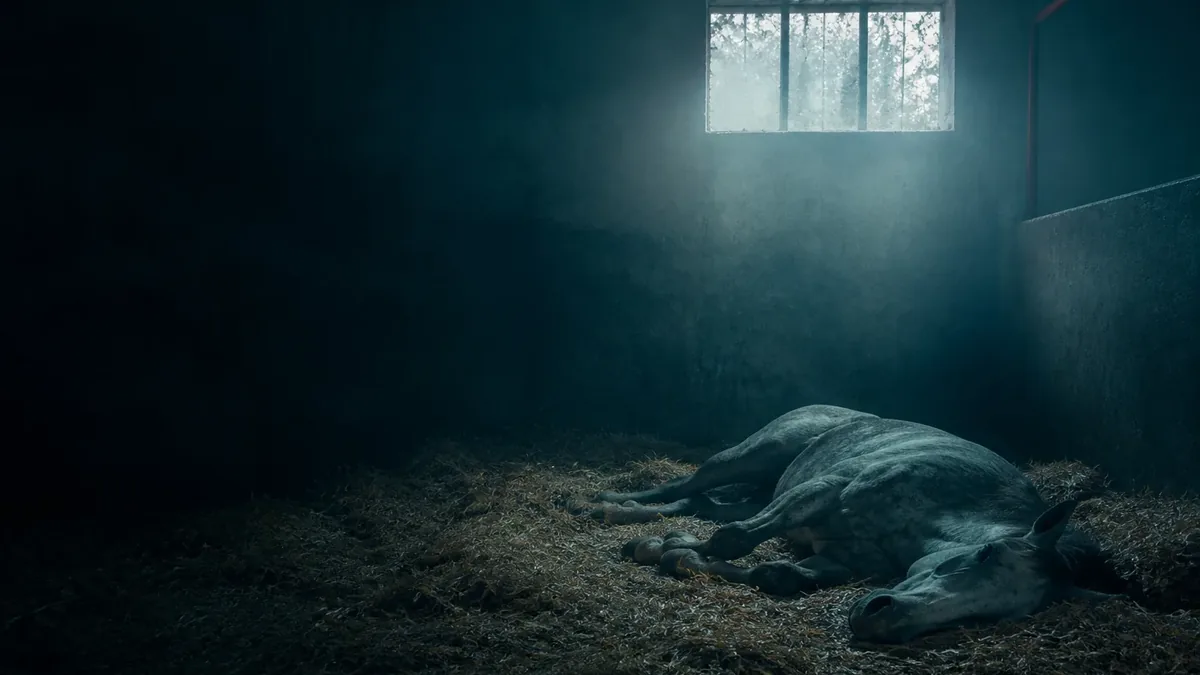
In REM sleep the muscles lose their tone, so a horse reaches this phase reliably only when lying down. Across the published work, roughly 231 minutes of total sleep and roughly 40 minutes of REM sleep per 24 hours have been measured, with very wide scatter between individual animals and between methods. The widespread minimum of 30 minutes of lying time is poorly supported: clinically unremarkable horses often fall below it.
20primary sources
20 %of them level 1 to 2
5species studied
2004–2026publication years
Key points
REM sleep in the horse presupposes lying down: because muscle tone falls away in this phase, it occurs stably only in lateral or sternal recumbency.
Averaged across the published work, a horse sleeps roughly 231 minutes in 24 hours, of which roughly 40 minutes are REM sleep; in humans the figures are roughly 430 and roughly 73 minutes.
The range says more than the mean: 172 to 262 minutes of total sleep in studies with brain-wave recording, 65 to 382 minutes in purely behavioural observation.
The widespread rule of at least 30 minutes of lying per day could be traced to only one place in the literature reviewed here, and there only as a reference to earlier work.
The only randomised trial kept ten horses from lying down for three days and found no statistically meaningful decline in two cognitive tasks, merely a trend.
In the horse, REM sleep is tied to lying down
In REM sleep, the phase in which dreaming occurs, the skeletal muscles lose their baseline tone. That relaxation is not a side effect of the state, it belongs to it. In the rodent it has been shown experimentally that several inhibitory messenger systems must act on the motor neurones at the same time for tone to fall away; if they fail, the result is either REM sleep with muscle tone preserved or, conversely, a loss of tone during waking. In the horse this mechanism has never been tested experimentally. It is a well-argued transfer from the rodent experiment, not a measurement made on the horse.
In the stable this has one simple consequence. A review of equine sleep records that, because of this loss of tone, REM sleep can occur only in lateral or sternal recumbency. Individual horses reach it standing as well, but only momentarily: the vanishing muscle tone makes the animal buckle, and the buckling itself ends the sleep again.
Is buckling while standing already REM sleep?
Possibly, but it is documented only in individual animals. In an overnight recording with brain-wave measurement in five neurologically unremarkable horses, one animal showed REM sleep while standing, accompanied by numerous partial collapses. The same work found that drowsiness and REM sleep can barely be told apart electrically, whereas deep sleep stands out clearly from both.
How long a horse really sleeps
Across the published work a horse sleeps markedly less than a human being, but above all it distributes its sleep differently. The share of REM sleep within total sleep time comes out almost the same in both species. What differs is the packaging: the horse's sleep cycle is roughly three times shorter, and within a cycle it wakes briefly many times over, which the adult human practically never does.
Mean values from the review of equine sleep, which sets the same parameters for horse and human side by side.
Parameter
Horse
Human
Total sleep per 24 hours
roughly 231 minutes
roughly 430 minutes
REM sleep per 24 hours
roughly 40 minutes
roughly 73 minutes
Share of REM sleep in total sleep
17.5 per cent
just under 17 per cent
Length of one sleep cycle
roughly 41 minutes
just under 120 minutes
Brief waking episodes per cycle
roughly seven
fewer than one
These averages, however, feign a precision that does not exist. The same review gives the ranges separately by method of measurement: in studies with brain-wave recording, total sleep time lay between 172 and 262 minutes, in studies relying on behavioural observation alone, between 65 and 382 minutes. The difference does not lie with the horse. It arises from whether sleep while standing is counted at all, and from how sleep is defined in the first place. The review therefore calls explicitly for a unified methodology for the behavioural measurement of sleep.
This problem is not confined to the horse. The analysis of 65 studies that established human normative values across the lifespan likewise records that the relationships found depended heavily on how strictly healthy participants had been selected: a normal value always describes the procedure that produced it as well.
Where the 30-minute rule comes from
Countless advice pages state that a horse must lie down for at least 30 minutes a day. In the literature reviewed here, that figure can be traced to exactly one place: a Swiss housing trial from 2017 cites it and refers for it to earlier work, not to a finding of its own. The dedicated review of equine sleep carries no such threshold. A Finnish study from 2026 uses it as the dividing line between short-sleeping and normally sleeping horses, without giving a source or a justification for it.
How little the line holds is shown by that same Finnish work. Of sixteen clinically unremarkable horses, ten fell below it, averaging roughly eleven minutes of apparent REM sleep, with individual values from zero to 28 minutes. The remaining six lay between just under 37 and roughly 66 minutes. None of these horses showed signs of a sleep disorder. A line below which the majority of a healthy group sits makes a poor requirement figure.
Is my horse ill if it hardly ever lies down?
That does not follow. Short lying times occur in clinically unremarkable horses too, and the scatter between individual animals is considerable. The picture becomes notable only when a horse stops lying down altogether for days on end, or when falls, night-time injuries or daytime sleepiness appear alongside it. That judgement belongs in veterinary practice.
What is usually measured is posture, not sleep
Most figures on equine sleep come not from the brain but from the camera. What is measured is lying, by video, by accelerometers or by position sensors. The Finnish work too assigned REM sleep from filmed posture, that is, from lateral or sternal recumbency with a relaxed neck no longer carrying the head. That is a surrogate measure: it describes a precondition of REM sleep, not REM sleep itself. A horse lying down may be awake, and a very brief episode of REM sleep while standing stays invisible.
Genuine polysomnography is rare. A German study recorded electrical brain activity, eye movements and muscle tone in ten foals for 48 hours each, together with video, in their own stable and with wireless equipment. It distinguished four states of wakefulness and four body postures. Its most important finding for the present text: the waveform of foals differs from the one published for adult horses. Figures from foalhood therefore cannot be carried over to adult horses.
How unreliable observation alone can be is shown by a study of eleven horses on the first-night effect. The first night in an unfamiliar place differed measurably from the following ones in electrical brain activity, most clearly over the back of the head, while behavioural observation did not pick that difference up. Anyone counting lying minutes after transport or at a show is therefore probably underestimating the actual disturbance of sleep.
When a horse stops lying down
How common the problem is can so far be estimated only through surveys. In a Nordic survey with 1,749 responses from owners and carers, a sleep disorder was suspected in 5.0 per cent of horses. Most strongly linked to that suspicion were observations that trigger the suspicion themselves: an unexpected loss of balance or a fall, a horse never seen lying down, difficulty getting down and getting up, night-time injuries and daytime sleepiness. That is partly circular reasoning and not an independent confirmation.
One feature of the environment nevertheless remained: the lying surface. A hard, wet surface went with a roughly ninefold higher chance of a suspected case, a hard, dry one with a roughly three-and-a-half-fold higher chance. Age and height at the withers acted weakly in the same direction. Since participation was voluntary and a case was defined solely by the owner's suspicion, these are associations, not causes.
What did not hold up is instructive. In 83 horses at a sanctuary fitted with automatic position sensors, neither age nor lameness from chronic orthopaedic disease had a meaningful influence on lying time, contrary to the researchers' expectation. Lying times ranged from zero to 319 minutes a day, averaging roughly 67. Only one group of eight horses with clinical signs of REM sleep deficiency stood clearly apart: they lay for roughly eight minutes on average, the others for roughly 74.
A very small trial points towards physical causes. Eight horses, four of them with angular limb deformity, were observed twice over several days. The affected animals lay for about half as long as the comparison animals, and under a painkiller the difference disappeared. The researchers accordingly put it cautiously: a shorter lying time could go together with musculoskeletal discomfort.
What the lying surface and the daily routine change
Swiss animal welfare legislation prescribes minimum dimensions for the bedded area in group housing. A trial with 38 horses in eight groups tested four variants: without bedding, and with half, one and one and a half times the minimum area, the rest of the floor being covered with hard rubber mats. Without bedding, lying became rare, and the majority of horses stayed under 30 minutes in 24 hours. As the bedded area grew, lying time rose, yet even at one and a half times the minimum area some individual animals still fell below.
What mattered was less the space than the availability of a soft, yielding surface, and rank within the group played its part. Low-ranking horses were forced to get up more often than high-ranking ones at half and at the full minimum area; only at one and a half times the area did the two become alike. The legal minimum dimensions therefore do not secure undisturbed lying for every member of a group.
Whether turnout and company additionally encourage lying is open. A trial with ten young riding horses compared a box, an individual paddock and a paddock shared in pairs. The expected increase in lying could not be confirmed statistically, and the researchers speak expressly of indications. All that is secure is that lying is heavily concentrated in the night, roughly eleven times longer than by day. Variation from day to day was very large within one and the same horse.
Narcolepsy and sleep deprivation are not the same thing
In the search engine the two terms often appear in the same headline, yet they describe different things. As early as 2006, two horses were described whose striking sleepiness was attributed to a lack of sleep while lying down and expressly not to narcolepsy. That case report yields nothing further: no abstract is indexed for it, and the figures cannot be checked. It establishes the distinction, not how common it is.
Familial narcolepsy has been described in the horse, but it is rare and built differently from the human condition. In three Lipizzaner half-sisters by the same sire it was assumed on clinical grounds and through a drug test. Hypocretin, the messenger whose deficiency defines human type 1 narcolepsy, lay within the normal range in the cerebrospinal fluid of all the animals examined. The signs had been present from an early age and gradually decreased in two of the three fillies from their second year of life.
What follows from little REM sleep is open
The only randomised trial on this question found nothing. Ten Lusitano horses were kept from lying down over three consecutive days and then tested in two tasks, one on spatial memory and one on attention. In both, only a trend towards longer times appeared, with no statistically meaningful decline. With ten animals of a single breed, however, a medium-sized effect is barely detectable that way. An absence of evidence is not evidence of harmlessness.
The Finnish observational study supplies a counterweight. Horses with short apparent REM sleep performed worse in a learning test in which the rewarded side was switched repeatedly, and they persisted less. The relationship concerned the number of switches mastered, not the error rate. This is an observation in sixteen animals and not proof of a cause.
In humans the direction is established, but the magnitude is modest. An analysis of 61 studies of short-term sleep restriction found an effect for three domains only: executive control, sustained attention and long-term memory. For multitasking, impulsive decisions and intelligence the data were insufficient. And the widespread notion that REM sleep serves above all to process emotion does not survive an analysis of more than a thousand comparisons: the advantage for emotional material was no greater after sleep than after staying awake.
Other species, other arithmetic
The comparison across species calls for further caution. A phylogenetic analysis of published sleep data showed that published sleep durations depend markedly on the laboratory conditions under which they were collected. If the analysis is restricted to data gathered in standardised fashion, the classical explanations of sleep no longer hold, namely energy saving, cognitive performance and development. The differences between species reflect ecological constraints instead, above all the competition between feeding and sleeping. The short sleeper among the equids named there is, incidentally, the donkey with roughly three hours, not the horse.
How far this can go is shown by two free-roaming elephant cows. They rested for roughly two hours a day on average, the shortest duration yet measured in a mammal, and lay down only every third or fourth day. After stretches of up to 46 hours without sleep they showed no recovery sleep at all. A large herbivore can therefore go without lying down for a long time with no compensation following. For the horse that is no model, but it is a reason not to assert a general daily lying requirement for large animals.
How young this research field is comes out in a marginal note. For the sleep of farmed ungulates, the protocol for a first systematic mapping of the literature was published only in 2026; at that point, then, no such overview existed at all. That protocol does not, however, name the horse explicitly.
Methods for measuring equine sleep: what each captures, what it cannot settle
Original analysis
From each of the twenty studies reviewed, the method of measurement used was extracted, set against the quantity directly recorded, and paired with the largest number of animals this article draws on for that method.
Method of measurement
What it captures directly
What it cannot settle
Largest number of animals in the literature used here
Polysomnography in the home stable: brain waves, eye movement, muscle tone and video at once
Sleep stages from the brain signal, synchronised with body posture
How common a finding is in a population
10 foals for 48 hours each
Overnight brain-wave recording with video away from familiar surroundings
Whether drowsiness, deep sleep and REM sleep are electrically separable
How a horse sleeps at home
5 adult horses
Brain-wave comparison across several nights in the same place
Whether the first night runs differently from the following ones
How much daytime performance suffers as a result
11 adult horses
Video observation of body posture
Lying time and position, from which apparent REM sleep is derived
Whether the animal was actually in REM sleep at the time
16 horses with five recordings each
Accelerometer or position sensor worn by the animal
Lying time and number of lying bouts over days to weeks
Sleep stages, and whether an interruption was forced
83 horses at a sanctuary
Controlled housing trial with varying lying area
How lying time responds to surface and area
Whether more lying also means more REM sleep
38 horses in eight groups
Survey of owners and carers
How often a suspicion is voiced and what it goes with
Whether the suspicion is correct in an individual case
1,749 responses
Limitations and uncertainty
Almost all the equine data in this article come from very small groups: five, eight, ten, eleven or sixteen animals, mostly at a single site. The editorial requirement to base at least half the sources on the level of systematic review, meta-analysis or randomised trial cannot be met in this field: on equine sleep there is exactly one randomised trial, and the remaining works at that level are human meta-analyses.
Most of the figures measure body posture, not sleep. Lying time, lying bouts and even the state counted as REM sleep are assigned in several studies by video or by sensors; whether the brain was in the corresponding sleep phase at the time is not tested there.
The review of equine sleep states neither inclusion criteria nor an assessment of the risk of bias. Its mean values pool studies with incompatible methods, which is why the separately reported ranges carry more information than the mean itself.
In the Finnish observational study the reference period of the reported REM sleep durations could not be determined with certainty, and the published overall mean does not add up against the means of the two subgroups. The subgroup values are therefore reproduced here deliberately without that overall figure.
The survey data on suspected sleep disorders rest on voluntary participation, and a case counted as a case only if the owner suspected a disorder. The strongest associations found are therefore partly built into the case definition already.
Two load-bearing references are more than five years old: the human normative values from 2004 and the mechanistic review of muscle atonia from 2011. Both are drawn on as foundational work, not as the current state of research.
Open questions
How much REM sleep does an adult horse actually need, and can a requirement be expressed sensibly as a number of minutes at all?
Does repeated collapsing while standing lead to measurable consequences for learning, metabolism or immune status, or does it remain a pure risk of injury?
Can REM sleep be inferred reliably from body posture, or does every statement of requirement necessarily need a measurement at the brain?
Does a horse make up missed lying sleep, as many mammals do, or does the compensation fail to appear, as it did in the two elephant cows studied?
Frequently asked questions
How many hours a day does a horse sleep?
Roughly four hours, though the figure is less certain than it sounds. Averaged across the published work, a horse reaches roughly 231 minutes of total sleep in 24 hours, of which roughly 40 minutes are REM sleep. The range is wide and depends on the method of measurement: 172 to 262 minutes in studies with brain-wave recording, 65 to 382 minutes in purely behavioural observation. The difference arises mainly from whether sleep while standing is counted and from how sleep is defined. A single value for the horse therefore describes the method rather than the animal.
Why does my horse suddenly buckle at the front while standing?
Because muscle tone falls away in REM sleep. If a horse reaches this phase while standing, the supporting musculature no longer holds, the animal sags, and the fall ends the sleep. In an overnight recording with brain-wave measurement in five horses, one animal showed exactly this pattern, accompanied by numerous partial collapses. Taken on its own, however, buckling proves no cause: pain on getting down, a restless or unsafe place to lie, and neurological disease are equally possible. What lies behind it in an individual case is settled only by a veterinary examination.
Is it true that a horse must lie down for at least 30 minutes a day?
The figure is widespread and weakly supported. In the literature reviewed here it appears traceably only in a Swiss housing trial, which itself takes it over from earlier work. The dedicated review of equine sleep knows no such threshold, and a Finnish study from 2026 uses it as a dividing line without naming a source. In that same study, ten of sixteen clinically unremarkable horses fell below it. As a prompt to look at the lying place at all, the figure serves; as a boundary between healthy and ill, it has not been tested.
Does my horse have narcolepsy if it seems tired during the day?
Usually not. Narcolepsy has been described in the horse, but it is rare: documented cases include a familial form in three Lipizzaner half-sisters, in which hypocretin, decisive in humans, was normal in the cerebrospinal fluid. The more frequent explanation for striking daytime sleepiness is a lack of sleep while lying down, a distinction already described in 2006 in two horses. How often each of the two causes applies is not captured in reliable figures. Working that out belongs in veterinary practice and not in a search engine.
Does it harm my horse if it hardly lies down in the show stable?
Harm is not established, but neither can the all-clear be given. The only randomised trial kept ten horses from lying down for three days and found no statistically meaningful decline in two cognitive tasks, merely a trend towards longer times. With ten animals of one breed, a medium-sized effect is barely detectable. Conversely, a study of eleven horses showed that the first night in an unfamiliar place is measurably disturbed in electrical brain activity, with nothing visible in the behaviour. The disturbance is therefore real, its consequences unquantified.
How do I tell that a lying place is unsuitable?
The data offer two pointers, no more. In a Nordic survey, a hard, wet lying surface was the only feature of the environment clearly associated with suspected sleep disorders, a hard, dry one considerably less so. In a Swiss housing trial, lying became rare without bedding, and even at one and a half times the legal minimum area some individual animals stayed under 30 minutes in 24 hours. Low-ranking horses were forced to get up more often. Both are observations from group housing; no recipe for an individual stable follows from them.
Sources
Greening L, McBride S. A Review of Equine Sleep: Implications for Equine Welfare. Frontiers in Veterinary Science, 2022 (Other | Horse)DOI 10.3389/fvets.2022.916737 A review without declared inclusion criteria: it records that REM sleep occurs only in lateral or sternal recumbency because of muscle atonia, and documents that published sleep durations depend massively on the method of measurement (172 to 262 minutes with brain-wave recording, 65 to 382 minutes in behavioural observation).
Barbosa AP, Oliveira TM, Trindade PHE, Seidel SRT. Sleep Pattern Interference in the Cognitive Performance of Lusitano Horses. Animals, 2024 (Randomised trial | Horse)DOI 10.3390/ani14020334 The only randomised trial of lying deprivation in the horse showed no statistically meaningful cognitive disadvantage in ten Lusitanos after 72 hours without lying down, only trends towards longer times in both tasks.
Hämäläinen MJ, Brotherus IL, Wigren HM, Kaimio TE. Effect of horse sleep behavior on performance in a field-side spatial reversal learning test. Scientific Reports, 2026 (Cohort study | Horse)DOI 10.1038/s41598-025-34463-9 In sixteen clinically unremarkable horses, short REM sleep derived solely from filmed posture went with poorer performance in a reversal learning test; ten of the sixteen animals stayed below the widespread threshold of 30 minutes, which the study applies without citing a source.
Suomala H, Brotherus I, Hänninen L, Ternman E. Risk factors associated with owner-reported sleep disturbances in Nordic horses. Equine Veterinary Journal, 2026 (Cross-sectional study | Horse)DOI 10.1111/evj.14560 In 1,749 responses from Nordic stables a sleep disorder was suspected in 5.0 per cent of horses; most strongly linked to it were behavioural observations that trigger the suspicion themselves, and, as the only environmental feature, a hard and wet or hard and dry lying surface.
Zanker A, Wöhr AC, Reese S, Erhard M. Qualitative and quantitative analyses of polysomnographic measurements in foals. Scientific Reports, 2021 (Case series | Horse)DOI 10.1038/s41598-021-95770-5 Polysomnography in ten foals for 48 hours each in their own stable: the waveform of foals differs from the one published for adult horses, and no sleep requirement and no lying threshold are derived from it.
Kelemen Z, Grimm H, Long M, Auer U. Recumbency as an Equine Welfare Indicator in Geriatric Horses and Horses with Chronic Orthopaedic Disease. Animals, 2021 (Cross-sectional study | Horse)DOI 10.3390/ani11113189 In 83 horses with automatic sensors, neither age nor orthopaedically caused lameness meaningfully influenced lying time, whereas a group of eight horses with signs of REM sleep deficiency stood out through an almost absent lying time.
Burla JB, Rufener C, Bachmann I, Gygax L. Space Allowance of the Littered Area Affects Lying Behavior in Group-Housed Horses. Frontiers in Veterinary Science, 2017 (Controlled trial | Horse)DOI 10.3389/fvets.2017.00023 The Swiss minimum dimensions for the bedded area did not secure undisturbed lying for all members of the group: even at one and a half times the minimum area some individual animals stayed under 30 minutes per 24 hours, and low-ranking horses were forced to get up more often; the study is at the same time the only one in the corpus that traces the 30-minute value back to earlier work.
Helmerich P, Bachmann I, Gygax L. Comparing lying behaviour of young riding horses on days in an individual indoor box, on an outdoor paddock alone, or in pairs and in the following night. Equine Veterinary Journal, 2025 (Controlled trial | Horse)DOI 10.1111/evj.14041 In ten young riding horses an increase in lying through turnout or company could not be confirmed statistically; all that is secure is that lying time was roughly eleven times higher at night than by day.
Clothier J, Small A, Hinch G, Barwick J. Using Movement Sensors to Assess Lying Time in Horses With and Without Angular Limb Deformities. Journal of Equine Veterinary Science, 2019 (Controlled trial | Horse)DOI 10.1016/j.jevs.2019.01.011 Four horses with angular limb deformity lay for about half as long as four comparison animals across two runs, and under a painkiller the difference became meaningless; the authors put this expressly as a possible link with musculoskeletal discomfort.
Williams DC, Aleman M, Holliday TA, Fletcher DJ. Qualitative and quantitative characteristics of the electroencephalogram in normal horses during spontaneous drowsiness and sleep. Journal of Veterinary Internal Medicine, 2008 (Case series | Horse)DOI 10.1111/j.1939-1676.2008.0096.x In five neurologically unremarkable horses, drowsiness and REM sleep were barely separable in the brain-wave signal, whereas deep sleep stood out clearly; one animal showed REM sleep while standing, though accompanied by numerous partial collapses.
Bergeler J, Liske-Schmitz A, Schmitz T, de Camp NV. First night effect alters occipital brain connectivity in horses. Scientific Reports, 2025 (Case series | Horse)DOI 10.1038/s41598-025-14830-2 In eleven horses a first-night effect was detectable in electrical brain activity, most clearly over the back of the head, while behavioural observation did not pick it up: lying minutes underestimate the disturbance of sleep in unfamiliar surroundings.
Ludvikova E, Nishino S, Sakai N, Jahn P. Familial narcolepsy in the Lipizzaner horse: a report of three fillies born to the same sire. The Veterinary Quarterly, 2012 (Case series | Horse)DOI 10.1080/01652176.2012.714089 In three Lipizzaner half-sisters a familial narcolepsy was assumed clinically and through a drug test, although hypocretin in the cerebrospinal fluid was normal: the equine form therefore does not correspond to hypocretin-related human type 1 narcolepsy.
Bertone JJ. Excessive drowsiness secondary to recumbent sleep deprivation in two horses. Veterinary Clinics of North America: Equine Practice, 2006 (Case series | Horse)DOI 10.1016/j.cveq.2005.12.020 Two case reports attributing striking sleepiness to a lack of sleep while lying down rather than to narcolepsy; since no abstract is indexed, the work carries this distinction alone and no figures.
Ohayon MM, Carskadon MA, Guilleminault C, Vitiello MV. Meta-analysis of quantitative sleep parameters from childhood to old age in healthy individuals: developing normative sleep values across the human lifespan. Sleep, 2004 (Meta-analysis | Human)DOI 10.1093/sleep/27.7.1255 Normative values from 65 studies in 3,577 healthy people: effect sizes depended strongly on how strictly participants were filtered, which weakened or masked age relationships; in humans too, then, a normal value is method-dependent.
Lowe CJ, Safati A, Hall PA. The neurocognitive consequences of sleep restriction: A meta-analytic review. Neuroscience and Biobehavioral Reviews, 2017 (Meta-analysis | Human)DOI 10.1016/j.neubiorev.2017.07.010 From 61 studies a modest disadvantage of short-term sleep restriction emerges in humans, detectable only for executive control, sustained attention and long-term memory; for multitasking, impulsive decisions and intelligence the data were insufficient.
Schäfer SK, Wirth BE, Staginnus M, Becker N. Sleep's impact on emotional recognition memory: A meta-analysis of whole-night, nap, and REM sleep effects. Sleep Medicine Reviews, 2020 (Meta-analysis | Human)DOI 10.1016/j.smrv.2020.101280 Across 1,059 observations, sleep did not generally improve recognition of emotional material; only a partial analysis of eight studies supports a special role for REM sleep over deep sleep.
Peever J. Control of motoneuron function and muscle tone during REM sleep, REM sleep behavior disorder and cataplexy/narcolepsy. Archives Italiennes de Biologie, 2011 (Other | Rodent)DOI 10.4449/aib.v149i4.1257 In the rodent it is experimentally established that muscle atonia in REM sleep requires several inhibitory messenger systems at once, and that their failure produces either REM sleep with tone preserved or loss of tone during waking; in the horse this mechanism has never been tested.
Capellini I, Barton RA, McNamara P, Preston BT. Phylogenetic analysis of the ecology and evolution of mammalian sleep. Evolution, 2008 (Other | Multiple species)DOI 10.1111/j.1558-5646.2008.00392.x Published sleep durations in mammals depend markedly on laboratory conditions; if only data gathered in standardised fashion are used, the classical functional explanations of sleep no longer hold, and the short sleeper named among the equids, with roughly three hours, is the donkey and not the horse.
Gravett N, Bhagwandin A, Sutcliffe R, Landen K. Inactivity/sleep in two wild free-roaming African elephant matriarchs - Does large body size make elephants the shortest mammalian sleepers?. PLoS One, 2017 (Case series | Other animal species)DOI 10.1371/journal.pone.0171903 Two free-roaming elephant cows slept roughly two hours a day, lay down only every third or fourth day and showed no recovery sleep after up to 46 hours without sleep: an ecological counterexample, not a model for the horse.
Dias G, Ternman E, Proudfoot K. Exploring sleep in farmed ungulates: A scoping review protocol. PLoS One, 2026 (Other | Other animal species)DOI 10.1371/journal.pone.0343334 A protocol without findings of its own: it establishes verifiably that no systematic mapping of the literature on the sleep of farmed ungulates existed as of 2026; the horse is not named explicitly in it.
ForschungPferd (2026). Sleep deprivation in the horse: why dreaming sleep needs the horse to lie down. ForschungPferd, English. https://forschungpferd.ch/en/comparative-health/equine-sleep-rem-recumbency/