Moon blindness in horses: leptospires, genes or the immune system?
82 per cent of clinically healthy horses reacted to leptospires: what serology, genetics and the autoimmune trail really establish, and what they do not.
Scientific reviewPosition not yet filled, stated openly.
11 min readLast substantive review
Open access
Executive summary
No single cause is established. Leptospires are detected far more often in diseased eyes than in healthy ones, yet antibodies in blood are common in healthy horses too, and the picture differs from country to country. Alongside this, an inherited predisposition is established several times over, above all in breeds with leopard complex spotting. The recurring inflammation itself is regarded as immune-mediated. On the cause, no systematic review exists to date.
21primary sources
10 %of them level 1 to 2
3species studied
2005–2026publication years
Key points
Antibodies against leptospires in blood are an ordinary finding: of 124 clinically healthy horses in Colorado, 82 per cent reacted to at least one of six serovars, and the pooled worldwide figure stands at 47.2 per cent.
In the eye the picture changes: in a Munich analysis of 1,840 intraocular samples, 83 per cent of the samples from diseased eyes were antibody positive, while in 216 healthy eyes not a single detection succeeded.
The picture depends heavily on the country: in the United Kingdom only 6.7 per cent of the diseased eyes examined showed a clear indication of infection within the eye, and in Icelandic horses no association could be shown at all.
The claim that moon blindness is not heritable is incompatible with the data: in Appaloosas the heritability of the insidious form is estimated at 0.68 to 1.0, of which the leopard complex locus explains only a part.
The only randomised trial on the causal chain covered 41 already diseased horses: the frequency of relapse did not fall in a way that could be secured, only the interval to the first relapse lengthened markedly.
Moon blindness is an old name for a recurrent inflammation of the eye
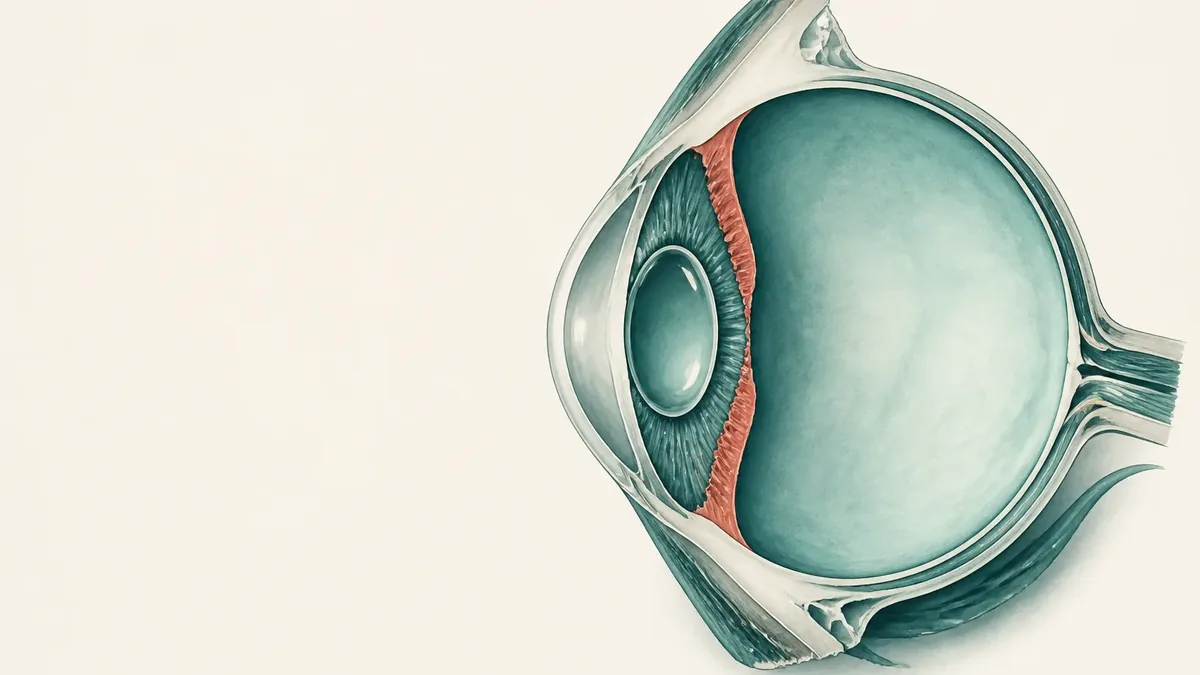
The name comes from a time when the episodes were linked to the phases of the moon. What is meant is equine recurrent uveitis: an inflammation of the middle coat of the eye that returns in episodes and that, with every episode, can destroy tissue. It is regarded as the most common cause of blindness in the horse. How widespread it is depends on the population and the breed: a German paper gives a range of 3 to 15 per cent for the horse population, and in individual breeds the measured proportions are considerably higher.
The disease appears in two guises. The classic form runs in painful, plainly visible episodes with avoidance of light, watering and a screwed-up eyelid. The insidious form remains outwardly inconspicuous and is often noticed only late. Among 138 Icelandic horses examined, five of the six affected animals had the insidious form, and 8 per cent of the horses aged eight years and over were affected.
Why is the cause so hard to name?
Because an eye is almost never examined until it has already been inflamed several times. Whatever is found in it then may be trigger or consequence. Added to this is a gap in the literature: on the cause there is to date no systematic review, and the available papers examine different breeds, countries and materials.
The first episode is not yet the disease
Anyone seeing an inflamed eye for the first time quickly thinks of moon blindness. The only paper that has followed a first episode prospectively says otherwise. In the United Kingdom, between 2014 and 2018, 23 horses with a first episode of primary uveitis and 46 comparison horses were observed. Around 59 per cent of the affected animals recovered and had no further episode, about 18 per cent suffered a relapse. A first episode is therefore an event with an open outcome, not a diagnosis made.
The same paper found two environmental factors that went along with the first episode: proximity to a pig unit and a recent flooding of the pasture. Long ownership by the same person, conversely, was associated with a lower risk. The estimates are, however, so imprecise that only the direction of the association can be read, not its strength. And not a single blood or eye sample was taken: the reading that leptospires are at work here is a consideration of the authors, not a measurement.
Clear in the eye, ambiguous in the blood
The largest collection of data on detection within the eye comes from Munich. Between 2002 and 2017, 1,840 intraocular samples were analysed there: 1,387 from eyes with recurrent uveitis, 237 from eyes with a different uveitis and 216 from healthy eyes. In the diseased eyes, 83 per cent of the samples were positive in the agglutination test, likewise 83 per cent in the ELISA and 72 per cent in the detection of genetic material. In the 216 healthy eyes and in the 237 other uveitis cases not a single antibody detection succeeded. The authors stress at the same time that no single test suffices to confirm or to rule out an infection within the eye.
A Belgian paper examined 66 diseased eyes and 50 eyes from horses that had been put down for reasons unrelated to the eye. Genetic material of leptospires was found in 30.3 per cent of the diseased eyes and in not one healthy eye. Detection within the eye is thus highly specific and at the same time not very sensitive. One methodological detail matters: aqueous humour and vitreous humour from the same eye agreed poorly. Anyone testing only one of the two fluids misses a share of the infections.
A second German series of 225 diseased horses turned out more reserved: 57.5 per cent had antibodies in blood, 35.1 per cent in the vitreous humour, and culture of the bacteria succeeded in only 16 per cent of the eyes examined. In 84 per cent the culture remained negative, culture of leptospires being regarded as difficult. From Switzerland there is an analysis of 65 diseased horses from the years 2010 to 2015: 28 of 65 blood samples and 31 of 65 aqueous humour samples were positive, and there was no healthy comparison group there.
Does a detection within the eye prove that leptospires triggered the episode?
No. It shows that the bacteria are present in the inflamed eye. Whether they triggered the first episode or settled in an eye that had already become permeable cannot be read off a snapshot. That would require horses examined before their first episode, and such data are missing.
Why the blood test does not answer the question
In Colorado, 124 clinically healthy horses were tested against six serovars. 82 per cent reacted to at least one of them, and the proportion rose with age. Being seropositive is therefore an ordinary state in horses and not an abnormality. The same paper found only that the serovar Pomona occurred more often among the clinical submissions than among the healthy animals, and expressly speaks of a correlation in doing so.
The worldwide order of magnitude comes from the only meta-analysis in the field so far. It brings together 35 cross-sectional studies from the years 2015 to 2025 and arrives at a pooled seroprevalence of 47.2 per cent, with wide differences between the continents: 71 per cent in North America, 27 per cent in Europe. This figure measures an exposure, not a disease, and the authors derive no causal link with moon blindness from it.
How strongly the picture depends on the country is shown by the United Kingdom. In 30 eyes removed because of recurrent uveitis, only 6.7 per cent carried a clear indication of infection within the eye, and seropositivity did not differ dependably between diseased and healthy horses: 65.5 against 41.9 per cent. In 138 Icelandic horses no association between serology and disease could be shown either in Denmark or in the United States, but only six cases were available there. That is not counter-evidence, it is a lack of power.
The only randomised trial on the causal chain
If leptospires sustain the disease, an intervention in the infection should change the course. Precisely this was tested once. 41 already diseased horses were allocated at random to two groups, 20 vaccinated and 21 not, and followed for a year. A relapse occurred in 7 of the 20 vaccinated and in 12 of the 21 remaining horses: a difference that could not be secured with groups of this size. The progression of the disease did not differ either. The only thing markedly lengthened was the interval to the first relapse, on average 126 days against 86.
The authors write expressly that these data do not support routine use of the vaccine as an accompanying treatment. Just as important is what the trial did not test at all: it examined horses that were already diseased and therefore says nothing about preventing a first episode.
The genetic trail, and why ‘not heritable’ is wrong
The claim that moon blindness is not heritable but is transmitted by leptospires is often to be read online. It is not compatible with the data. In 142 Appaloosas the heritability of the insidious form was estimated at 0.68 to 1.0, of which the known leopard complex locus explains only 0.16 to 0.33. Further hereditary factors must therefore be involved. Individual model calculations produced values above 1, which shows the instability of the estimate and counsels caution about the exact figure.
In western Canada, 145 Appaloosas were examined and genotyped. 14 per cent had a confirmed recurrent uveitis, and the average age of the affected animals was a good twelve years. Homozygous carriers of the leopard allele showed roughly 19 times the odds of horses without this allele, and with every year of life the risk rose further. The kinship was striking: a single affected stallion was the sire or grandsire of nine further affected horses. In the Knabstrupper the pattern repeated itself: 20.7 per cent of the 116 horses examined had an insidious uveitis, and the cases were more closely related to one another than the comparison horses.
The finding is not a peculiarity of spotted breeds. In 144 German warmblood horses without leopard complex spotting a risk signal lies in the immediate neighbourhood of the genes for interleukin 17, a messenger of the immune system. In Appaloosas, markers in the region of the major histocompatibility complex were added, that region of the genome which also turns up in other immune-mediated diseases. In Icelandic horses a signal appeared in the gene TIMP2, though in only eleven cases, and a 2025 paper found a second region on the X chromosome in Appaloosas. None of these findings so far names a causal change in the genome: they are addresses, not mechanisms.
Is moon blindness heritable, then?
A predisposition yes, the disease itself not in the sense of a simple pattern of inheritance. Risk regions have been found in two breeds with leopard complex spotting and in warmblood horses, and in Appaloosas the hereditary component explains a large part of the differences. The authors of the Knabstrupper paper recommend genotyping for assessing risk, expressly not as a test that establishes the disease.
The autoimmune trail explains why the episodes return
The third trail answers a different question from the first two. It does not explain why an eye falls ill for the first time, but why it falls ill again and again. A 2016 review describes the mechanism thus: irrespective of the original trigger, the blood-ocular barrier becomes permeable with every episode, defence cells reach the eye and turn against the body's own structures. Over time the reaction spreads to further components, and antibodies are often found in the eye at a higher concentration than in the blood.
A laboratory paper from 2022 connects the trails instead of playing them off against each other. In vitreous humour samples from diseased horses, markers of what are called neutrophil extracellular traps could be detected, net-like structures made from the genetic material of defence cells. Their extent went along partly with the severity of the ocular changes and partly with the detection of leptospires, and the vitreous humour of diseased horses proved toxic to cells of the retinal pigment epithelium. The samples come from operations on the most severe cases: these are associations in the laboratory, and no sequence in time in the living animal can be derived from them.
The most recent review of the risk factors sums up the position in 2023 as follows: a complex origin involving the immune system, with environmental and hereditary components that act in individual cases or in all of them. The primary triggers, it says, are still being sought. This is a narrative review without a fixed search protocol: it describes the state of the debate, it does not settle it.
Why the sources contradict each other, and what follows from that
Three differences explain the greater part of the contradiction between the advice pages.
The horses examined are not the same: a clinic specialising in vitreous surgery sees the most severe and longest standing cases, and often precisely those in which leptospirosis had already been suspected.
The tests do not measure the same thing: antibodies in blood, antibodies in the eye, detection of genetic material and culture deliver very different proportions in the same populations.
The spread of the bacteria differs by region, and the serovar panels tested differ from country to country, which makes figures from Munich, Liverpool and Zurich incomparable.
The question ‘leptospires or genetics or autoimmune reaction’ is therefore wrongly put. The available data are compatible with a layered picture: a predisposition that is considerable in some breeds, a trigger that in a share of the horses may be an infection, and an inflammation that afterwards sustains itself. This picture is not established. It is the most economical explanation for findings that would otherwise rule one another out.
Detection of leptospires in moon blindness: the same question, eight data sets, incomparable figures
Original analysis
For every study cited in this article it was recorded who was examined, which material was tested by which method, how high the proportion of positive findings turned out to be and whether healthy comparison animals ran alongside in the same data set; only the last column makes visible why the percentages of these papers cannot be compared with one another.
Data set and country
Horses examined
Material and method
Proportion positive
Healthy comparison animals in the same data set
Vitrectomy centre Munich, 2002 to 2017
1,387 eyes with recurrent uveitis
Aqueous and vitreous humour: agglutination test, ELISA, detection of genetic material
83 / 83 / 72 per cent
216 healthy eyes, not a single antibody detection
Second German series
225 horses with recurrent uveitis
Blood and vitreous humour: antibodies and culture
57.5 per cent in blood, 35.1 per cent in vitreous humour, 16 per cent culture
20 control horses, 10 of them seropositive, no positive culture
University clinic, Belgium
66 diseased eyes from 59 horses
Aqueous and vitreous humour: detection of genetic material
30.3 per cent
50 healthy eyes, not a single detection
Vetsuisse Zurich, 2010 to 2015
65 diseased horses
Blood and aqueous humour: agglutination test
28 of 65 in blood, 31 of 65 in aqueous humour
no healthy comparison group available
United Kingdom, removed eyes
30 eyes with uveitis confirmed on tissue examination
Blood and ocular contents: agglutination test
6.7 per cent with a clear indication of infection within the eye
43 comparison eyes, seropositivity without a dependable difference
Colorado, clinically healthy horses
124 healthy horses
Blood: agglutination test against six serovars
82 per cent
not applicable, here the healthy animals are the ones examined
Icelandic horses in Denmark and the United States
138 horses, 6 of them with recurrent uveitis
Blood and full ocular examination
no association between serology and disease
132 horses without recurrent uveitis in the same survey
Meta-analysis of 35 cross-sectional studies, worldwide
mixed populations, 2015 to 2025
Blood: agglutination test
47.2 per cent pooled, Europe 27, North America 71 per cent
none, the paper measures exposure and not disease
Limitations and uncertainty
On the cause of moon blindness no systematic review exists. The editorial requirement to base at least half of the sources on the level of systematic review, meta-analysis or randomised trial cannot be met here: of 21 papers used, two reach that level, and the meta-analysis measures an exposure, not the disease. Everything else consists of case-control, cross-sectional, association and laboratory studies.
The most striking detection figures come from centres specialising in vitreous surgery. The most severe, longest standing cases end up there, frequently because of an existing suspicion of leptospirosis in the first place. The proportion of 83 per cent describes a series of patients, not the horse population.
The studies measure with different methods, different thresholds and different serovar panels. Their percentages therefore cannot be set directly against one another, and part of the contradictions between countries could go back to these differences rather than to genuine biological differences.
The genetic papers rest on small groups, mostly under 150 animals, concern individual breeds and have largely not been repeated independently. The risk regions reported are addresses in the genome; a causal change in the genome has so far been demonstrated in no breed.
From Switzerland only one analysis of 65 diseased horses is available, and it contains no healthy comparison group. Dependable figures on the frequency of moon blindness in the Swiss horse population could not be found in this research.
The laboratory paper on the involvement of defence cells rests on samples obtained during operations and on cell cultures. It shows associations, not a sequence in time in the living animal, and therefore permits no statement about what is cause and what is consequence.
Open questions
Do leptospires trigger the first episode, or do they settle in an eye whose blood-ocular barrier is already damaged?
Why do so many healthy horses carry antibodies without ever falling ill, and what distinguishes the few who do from them?
Can the genetic risk regions be repeated in independent groups outside the breeds with leopard complex spotting?
Do the classic and the insidious course have different causes, or are they two faces of the same disease?
Frequently asked questions
Is moon blindness heritable?
A predisposition is established, a simple pattern of inheritance is not. In 142 Appaloosas the heritability of the insidious form was estimated at 0.68 to 1.0, of which the leopard complex locus explains only 0.16 to 0.33. In western Canada 14 per cent of 145 Appaloosas examined were affected, and homozygous carriers of the leopard allele markedly more often. In the Knabstrupper the pattern repeated itself, and even in warmblood horses without leopard complex spotting a risk region was found. The widespread claim that the disease is not heritable is not compatible with these data. Conversely, no single difference in the genome has so far been demonstrated as a cause.
My horse had an inflammation of the eye. Is that already moon blindness?
Not necessarily, and mostly not. In the only paper that has followed the first episode of a primary uveitis prospectively, around 59 per cent of the 23 horses concerned recovered without ever having a further episode; about 18 per cent suffered a relapse. One speaks of recurrent uveitis only when the inflammations return. Whether the case in hand is an injury, another disease of the eye or the beginning of a recurring inflammation is decided solely by the veterinary examination, and that should take place promptly.
The blood test for leptospires was positive. Does that mean the leptospires are to blame?
No, a positive blood test on its own says very little. Of 124 clinically healthy horses in Colorado, 82 per cent reacted to at least one of six serovars, and the pooled worldwide figure stands at 47.2 per cent. Antibodies in blood attest to contact with the organism, not to a disease of the eye. In a British paper seropositivity did not differ dependably between diseased and healthy horses. Detection in the eye itself carries more weight, and there too the rule holds: no single test suffices, as the authors of the largest series expressly record.
Does vaccination against leptospires protect against moon blindness?
This question is unanswered. The only randomised trial included 41 already diseased horses: 7 of the 20 vaccinated and 12 of the 21 unvaccinated horses suffered a relapse, a difference that could not be secured with groups of this size. The progression did not differ either; only the interval to the first relapse lengthened markedly. The authors write that their data do not support routine use as an accompanying treatment. On preventing a first episode in healthy horses no such study exists at all.
Why does one website write that the disease is not heritable and another that it is autoimmune?
Because both reproduce one part of the literature each. The leptospire trail rests on German series from specialised clinics, in which the organism is found in the great majority of diseased eyes. The autoimmune trail describes what sustains the episodes, irrespective of the first trigger. The genetic trail comes predominantly from breeds with leopard complex spotting. Since no systematic review of the cause exists, there is no authority that weighs these findings: the contradiction of the advice pages mirrors a real contradiction in the literature.
Are Appaloosas and Knabstruppers really affected more often?
Yes, markedly so in the surveys available. Among 145 Appaloosas examined in western Canada, 14 per cent had a confirmed recurrent uveitis; among 116 Knabstruppers, 20.7 per cent had an insidious form. By comparison, a German paper gives a range of 3 to 15 per cent for the horse population as a whole. In both breeds homozygous carriers of the leopard allele were affected more often, and the diseased animals were more closely related to one another than the comparison horses. These are cross-sectional surveys in one region each, and the figures do not transfer to every population.
Sources
Kingsley NB, Sandmeyer L, Bellone RR. A review of investigated risk factors for developing equine recurrent uveitis. Veterinary Ophthalmology, 2023 (Other | Horse)DOI 10.1111/vop.13002 The most recent review of the risk factors describes a complex autoimmune origin with environmental and hereditary components and records that the primary triggers are still being sought; it is a narrative review without a search protocol and without an assessment of the risk of bias.
Witkowski L, Cywinska A, Paschalis-Trela K, Crisman M. Multiple etiologies of equine recurrent uveitis - A natural model for human autoimmune uveitis: A brief review. Comparative Immunology, Microbiology and Infectious Diseases, 2016 (Other | Multiple species)DOI 10.1016/j.cimid.2015.11.004 Brief review: the causes are multiple, with leptospiral infection and hereditary predisposition regarded as the most important risk factors, and irrespective of the trigger it is the repeated disturbance of the blood-ocular barrier that sustains the disease, while the immune response spreads to further structures of the body itself.
Malalana F, Ireland JL, Pinchbeck GL, McGowan CM. Risk factors for a first episode of primary uveitis in the UK and proportion of cases that experience recurrence following this first episode. Equine Veterinary Journal, 2023 (Case-control study | Horse)DOI 10.1111/evj.13576 In 23 cases and 46 comparison horses, proximity to a pig unit and a recent flooding of the pasture were linked to a first uveitis episode, long ownership to a lower risk; 59.1 per cent of the cases remained free of relapse, 18.2 per cent suffered a relapse, and no biological samples were taken.
Geiger T, Gerhards H, Bjelica B, Mackenthun E. Analysis of 1840 Equine Intraocular Fluid Samples for the Presence of Anti-Leptospira Antibodies and Leptospiral DNA and the Correlation to Ophthalmologic Findings in Terms of Equine Recurrent Uveitis (ERU)-A Retrospective Study. Veterinary Sciences, 2022 (Case-control study | Horse)DOI 10.3390/vetsci9080448 In 1,387 eyes with recurrent uveitis, 83 per cent of the samples were positive in the agglutination test and in the ELISA and 72 per cent in the detection of genetic material, while in 216 healthy eyes and 237 eyes with a different uveitis no antibody detection succeeded; the authors stress that several tests must be combined.
Sauvage AC, Monclin SJ, Elansary M, Hansen P. Detection of intraocular Leptospira spp. by real-time polymerase chain reaction in horses with recurrent uveitis in Belgium. Equine Veterinary Journal, 2019 (Cross-sectional study | Horse)DOI 10.1111/evj.13012 Genetic material of leptospires was found in 30.3 per cent of 66 diseased eyes and in none of the 50 healthy comparison eyes; aqueous and vitreous humour from the same eye agreed only weakly, which is why the authors recommend testing both fluids where possible.
Dorrego-Keiter E, Toth J, Dikker L, Sielhorst J. [Detection of leptospira by culture of vitreous humor and detection of antibodies against leptospira in vitreous humor and serum of 225 horses with equine recurrent uveitis]. Berliner und Munchener Tierarztliche Wochenschrift, 2016 (Cross-sectional study | Horse)PMID 27344913 In an independent German series, 57.5 per cent of the diseased horses had antibodies in blood and 35.1 per cent in the vitreous humour, while culture succeeded in only 16 per cent of the eyes examined; 10 of 20 control horses were seropositive, without a single positive culture.
Voelter K, Vial Z, Pot SA, Spiess BM. Leptospiral antibody prevalence and surgical treatment outcome in horses with Equine Recurrent Uveitis (ERU) in Switzerland. Veterinary Ophthalmology, 2020 (Case series | Horse)DOI 10.1111/vop.12767 In the only Swiss data set, 28 of 65 blood samples and 31 of 65 aqueous humour samples from diseased horses were antibody positive, most often against the serovars Grippotyphosa, Pomona and Bratislava; it is a retrospective case series from a single centre without a healthy comparison group.
Fagre AC, Mayo CE, Pabilonia KL, Landolt GA. Seroprevalence of Leptospira spp. in Colorado equids and association with clinical disease. Journal of Veterinary Diagnostic Investigation, 2020 (Cross-sectional study | Horse)DOI 10.1177/1040638720943155 Of 124 clinically healthy horses, 82 per cent reacted to at least one of six serovars tested, with the proportion rising with age; only the serovar Pomona occurred more often among the clinical submissions, which the authors expressly call a correlation.
Concha D, Azocar-Aedo L, Ricardo T, Rodriguez A. Epidemiological evidence of anti-Leptospira antibodies in horses at a global level (years 2015 to 2025): a systematic review and meta-analysis. Journal of Equine Veterinary Science, 2026 (Meta-analysis | Horse)DOI 10.1016/j.jevs.2026.106058 From 35 cross-sectional studies a pooled seroprevalence of 47.2 per cent emerges, with wide differences between the continents, from 71 per cent in North America to 27 per cent in Europe; the paper measures an exposure and derives no causal link with recurrent uveitis.
Malalana F, Blundell RJ, Pinchbeck GL, McGowan CM. The role of Leptospira spp. in horses affected with recurrent uveitis in the UK. Equine Veterinary Journal, 2017 (Case-control study | Horse)DOI 10.1111/evj.12683 In the United Kingdom only 2 of 30 diseased eyes showed a clear indication of infection within the eye, and seropositivity did not differ dependably between diseased and healthy horses, which is why the authors rate the leptospire-associated form as rare there and call blood serology unsuitable for diagnosis.
Henriksen ML, Dwyer AE, Krarup Nielsen R, Backlund S. Ocular abnormalities in the Icelandic horse with a focus on equine recurrent uveitis: 112 Icelandic horses living in Denmark and 26 Icelandic horses living in the United States. Veterinary Ophthalmology, 2022 (Cross-sectional study | Horse)DOI 10.1111/vop.12961 In 138 Icelandic horses the frequency of recurrent uveitis from eight years of age was 8 per cent, five of the six affected animals had the insidious form, and leptospiral serology was linked to the disease neither in Denmark nor in the United States, though on only six cases.
Rathinam SR, Vedhanayagi R, Radhika M, Balamurugan MS. Why do Doctors Miss the Diagnosis of Leptospiral Uveitis? Emergence of New Serovars and Challenges in Diagnosis. Ocular Immunology and Inflammation, 2024 (Cross-sectional study | Human)DOI 10.1080/09273948.2023.2291477 Of 3,658 cases of uveitis assigned clinically to leptospirosis in humans, only 34.7 per cent were positive in the blood test, and the detection rate fell over the years from 92 to 35 per cent; the paper serves here solely as evidence that a negative antibody test does not rule out involvement, and permits no transfer to the horse.
Rohrbach BW, Ward DA, Hendrix DVH, Cawrse-Foss M. Effect of vaccination against leptospirosis on the frequency, days to recurrence and progression of disease in horses with equine recurrent uveitis. Veterinary Ophthalmology, 2005 (Randomised trial | Horse)DOI 10.1111/j.1463-5224.2005.00367.x In 41 already diseased horses over one year, vaccination reduced neither the frequency of relapse (7 of 20 against 12 of 21) nor the progression in a way that could be secured; only the interval to the first relapse lengthened markedly, and the authors record that the data do not support routine use as an accompanying treatment.
Kingsley NB, Sandmeyer L, Norton EM, Speed D. Heritability of insidious uveitis in Appaloosa horses. Animal Genetics, 2022 (Case-control study | Horse)DOI 10.1111/age.13267 In 59 diseased and 83 healthy Appaloosas the heritability of insidious uveitis was estimated at 0.68 to 1.0, of which the leopard complex locus explains only 0.16 to 0.33; estimates above 1 show the instability of the model and counsel caution about the exact figure.
Sandmeyer LS, Kingsley NB, Walder C, Archer S. Risk factors for equine recurrent uveitis in a population of Appaloosa horses in western Canada. Veterinary Ophthalmology, 2020 (Cross-sectional study | Horse)DOI 10.1111/vop.12749 Among 145 Appaloosas examined, 14 per cent had a confirmed recurrent uveitis; homozygous carriers of the leopard allele showed roughly 19 times the odds of horses without the allele, the risk rose with age, and a single affected stallion was the sire or grandsire of nine further affected animals.
Kingsley NB, Sandmeyer L, Parker SE, Dwyer A. Risk factors for insidious uveitis in the Knabstrupper breed. Equine Veterinary Journal, 2023 (Cross-sectional study | Horse)DOI 10.1111/evj.13879 In 116 Knabstruppers the frequency of insidious uveitis was 20.7 per cent, homozygous carriers and older horses were affected more often, and the cases were more closely related to one another than the comparison horses; the authors recommend genotyping for assessing risk, not as a diagnostic test, and the uncertainty range of the main result is open at the upper end.
Kulbrock M, Lehner S, Metzger J, Ohnesorge B. A genome-wide association study identifies risk loci to equine recurrent uveitis in German warmblood horses. PLoS One, 2013 (Case-control study | Horse)DOI 10.1371/journal.pone.0071619 In 144 German warmblood horses without leopard complex spotting a risk signal lies beside the genes for interleukin 17A and 17F and explains a considerable share of the spread of the trait, while a second signal concerns a group of crystallin genes; the authors speak of an indication of a genetic component, not of proof, and give a frequency of 3 to 15 per cent for the horse population.
Fritz KL, Kaese HJ, Valberg SJ, Hendrickson JA. Genetic risk factors for insidious equine recurrent uveitis in Appaloosa horses. Animal Genetics, 2014 (Case-control study | Horse)DOI 10.1111/age.12129 In Appaloosas two separate regions are linked to insidious uveitis, that of the leopard complex gene TRPM1 and that of the equine major histocompatibility complex, which connects the disease to immune-mediated conditions; no causal difference in the genome was found.
Kingsley NB, Sandmeyer L, Dwyer A, Langefeld CD. A genome-wide investigation of insidious uveitis in Appaloosa horses. BMC Genomics, 2025 (Case-control study | Horse)DOI 10.1186/s12864-025-12099-3 A second risk region on the X chromosome is added to leopard complex spotting, without the model supporting a joint action of the two; none of the 102 genomic differences tested by whole genome sequencing proved decisive, and the authors call for independent repetition before anyone speaks of a causal risk locus.
Hack Y, Henriksen ML, Pihl TH, Nielsen RK. A genetic investigation of equine recurrent uveitis in the Icelandic horse breed. Animal Genetics, 2022 (Case-control study | Horse)DOI 10.1111/age.13200 With only eleven diseased Icelandic horses a single signal in an intron of the gene TIMP2 reaches the genome-wide threshold, yet the one coding difference found does not fit the clinical picture; the paper describes itself expressly as exploratory and calls for more horses and more markers.
Fingerhut L, Yucel L, Strutzberg-Minder K, von Kockritz-Blickwede M. Ex Vivo and In Vitro Analysis Identify a Detrimental Impact of Neutrophil Extracellular Traps on Eye Structures in Equine Recurrent Uveitis. Frontiers in Immunology, 2022 (Laboratory study | Horse)DOI 10.3389/fimmu.2022.830871 Markers of neutrophil extracellular traps could be detected in the vitreous humour of diseased horses and went along partly with the severity of the ocular changes and partly with the detection of leptospires, and the vitreous humour of diseased animals acted toxically on cells of the retinal pigment epithelium; these are associations from surgical samples and cell cultures, without a sequence in time in the living animal.
ForschungPferd (2026). Moon blindness in horses: leptospires, genes or the immune system?. ForschungPferd, English. https://forschungpferd.ch/en/equine-health/equine-recurrent-uveitis-causes/